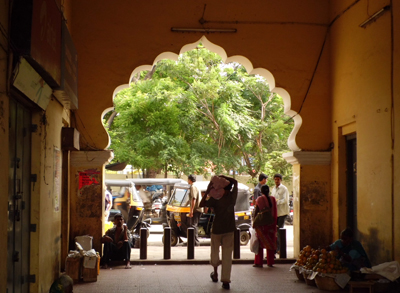
but, where was the market? There was nothing to identify this as a market building. Nothing to identify it as a market street either. There was no street. Just some space between randomly built one-storeyed brick and concrete structures. There were flowers everywhere. People selling flowers. People buying flowers.
From the street outside, I had seen huge flower garlands in yellow, crimson and green. If it wasn’t the size of those garlands, I would have never noticed the flower vendors. I would not have sensed that perhaps I could walk between these two shops and there would be something beyond.
I walked towards the flower shops and then between them. It was just more yellow, crimson and green garlands on both sides. Couldn’t see anything or anybody. Then, heard voices of vendors calling out to ask if I wanted to buy. That was for a brief moment. What the eyes saw just completely erased the words in the air. I didn’t hear them anymore.
The market had no “entrance”. Yet, if this was not a magnificent way to enter any place, what was? I still can’t get over the fact that I would have never known that I could enter a flower market here.
Further down, there were more shops selling flowers. It was a busy time. It was 8.30 in the morning. Sacks full of loose flowers being weighed on large weighing scales everywhere one went. No designated paths for customers. No designated operation spaces for vendors. Could I derive from this a plan for the marketplace? It just seemed like a ‘plan with no plan’.
I remembered then the walk through Pedana, a town near Machilipatnam in Andhra Pradesh where a little boy had taken us through a random but informative weaving tour as we went through a back alley into a weaver’s house, through a courtyard where yarn was being dyed and through the interior where the weavers sat at their looms and again through the frontyard into yet another street. I think informal economy anywhere in India creates the same sense of ‘place’ – one that cannot be defined or fathomed but one that has a presence nevertheless.
From this series of shops, if I turned left it took me to this tea stall which I had seen from the street earlier. The tea stall was not so far from the “street corner” I had sat at the previous morning, at the junction of Asaliamman Koil street and Tiruvoodal street. I retraced my steps back from the tea stall to the small junction in the flower market that I had first arrived at and turned right. More shops. Many transactions.
There was a continuous stream of people with large sacks of flowers on their heads climbing steps and disappearing behind the houses there. There was perhaps something more behind there. I climbed the steps. Where was this going to lead to? I came out onto a street. There were clay pots everywhere. I had seen this corner before. It was the corner you reached if you turned right from the main east entrance of the Arunachaleswarar temple.
A few houses, paths between houses and a flower market had happened. There was maybe nothing to plan? Markets in India just happened, where people walked and where paths crossed. Was anyone asking, ‘Is this a good location?’ ‘Is this a good plan?’ or ‘Is this a good design?’. It seemed not to matter. ‘Was business here good?’ ‘How did one begin to sell here?’ or ‘How much income could one make with selling of flowers?’ Those were the questions that mattered to a vendor and a ‘place for exchange’ perhaps had to be able to answer that.
Showing posts with label India. Show all posts
Wednesday, February 27, 2013
Monday, October 01, 2012
Grand Central Terminal market
There are times when you have thoughts that run through your mind one after another from a different place and a different time – thoughts of walking through a market in a New York train station, of a story called ‘Hugo’ unfolding inside a Paris railway station and of memories emanating from the Victoria Terminus in Mumbai.
You look at these thoughts as they pass by like you were looking at a roll of film unfold before you. These are negatives that are placed side by side in your mind but are geographically located in different continents. Something binds them – they all hold within them histories of the railroad and of the time when the making of a “place” came about from detailing a ceiling, a grand clock or a monumental turret in a way that generations later, we still wonder about how time could stand still then as it never does now to make such inspiring work possible.
The experience of the Grand Central Terminal in New York city and the market within it are heightened in my mind with the imagery of Martin Scorcese’s 2011 film ‘Hugo’ particularly the opening scenes of the little boy looking through the hands of the station clock and the story’s simultaneous perception of ingenuity in the making of clocks and in the making of films with the railroad station as its backdrop.
.
I really liked the way Tony Hiss describes the Grand Central Terminal in his book The Experience of Place - “The main concourse of Grand Central – an enormous room, with 14 entrances – is only one part of an intricate structure that was opened to the public in February of 1913 and is justly famous as a crossroads, a noble building, an essential part of midtown Manhattan, and an ingenious piece of engineering that can handle large numbers of trains, cars and people at once. It was designed to handle huge crowds and to impress people with the immensity and the dignity of enclosed public places in a modern city. From the accounts left by its builders however, it was not designed to provide the experience actually available there today. That experience is one of the unplanned treasures of New York.” There is more about its history and its design here.
The market at Grand Central Terminal is where you go to for gourmet food – for artisanal cheese and bread, for speciality coffee beans, for hard-to-get spices, for fresh fish and for gourmet chocolates. You can read here an interesting description of the food merchants, including Zaro’s, Murray’s cheese and Penzeys spices, amongst many others. The market is located on the east side of Grand Central. It can be entered either from inside the Grand Central or from the entrance at Lexington avenue at East 43rd street. I entered the market from inside the Grand Central and after the overwhelming experience of the railroad station, when you walk through the market and come onto Lexington avenue, it seems as if it's one entrance connects you to the city's past and its other entrance to the city's future.
The Grand Central market came into being when a revitalisation plan was commissioned for the Grand Central Terminal in 1990. A $425 million master plan was presented at a public hearing and subsequently adopted in concept by the Metropolitan Transportation Authority. The retail specialists Williams Jackson Ewing had been asked to prepare a master retail plan to address services and amenities and the “new” Grand Central was reopened in 1998.
As I think about the Grand Central Terminal and its market, I recollect the days in Mumbai from twenty years ago when we travelled by the local trains starting and ending at the Victoria Terminus in Mumbai. It is a building designed by the British architect F.W.Stevens and built over ten years starting in 1878. It is an example of Victorian Gothic Revival architecture blended with elements from traditional Indian architecture. It became a symbol for Mumbai as a mercantile port city within the British Commonwealth. The building was originally intended to house the railway station and the offices of the Great Indian Peninsula Railway. A number of ancillary buildings were added later, but it never had a market planned within it. The original building is still in use for suburban traffic and is used by over 3 million commuters daily. (Source: UNESCO World Heritage list )
Crawford market in Mumbai
The Victoria Terminus could have had a market section within it similar to the Grand Central Terminal market and it may have been successful with its floating population being extremely high. However, the Crawford market, just north of the Victoria Terminus had been completed in 1869. It is another magnificent structure of Mumbai with a built-up area of 6,000 sq.ft. It was designed by the British architect William Emerson and is a blend of Norman and Flemish architectural styles. It has been primarily a fruit, vegetable and poultry market with the merchants also selling imported food and cosmetics.
In Mumbai, the experiences of the Crawford market, the Victoria Terminus and the Flora Fountain, built in 1864 are woven together. The Hornby road (now named D.N.Road) linked the Crawford market to the Flora Fountain with several Neo-classical and Gothic Revival buildings built on commercial plots along the broad avenue road. Over the years, the market building had grown into an urban precinct with intersecting streets of formal and informal vendors selling textiles, stationery and household goods. This is an experience different from that of the Grand Central Terminal Market, where it is one street lined with shops on its either side and yet both the Grand Central Market and the Crawford market are part of the histories of railroad stations – one, in New York city and the other in Mumbai.
Related Post:
The Marketplace: Lonely Planet Blog Carnival
Faneuil hall marketplace
Marketplaces of the world: a Listing
Street corner in Mumbai
You look at these thoughts as they pass by like you were looking at a roll of film unfold before you. These are negatives that are placed side by side in your mind but are geographically located in different continents. Something binds them – they all hold within them histories of the railroad and of the time when the making of a “place” came about from detailing a ceiling, a grand clock or a monumental turret in a way that generations later, we still wonder about how time could stand still then as it never does now to make such inspiring work possible.
The experience of the Grand Central Terminal in New York city and the market within it are heightened in my mind with the imagery of Martin Scorcese’s 2011 film ‘Hugo’ particularly the opening scenes of the little boy looking through the hands of the station clock and the story’s simultaneous perception of ingenuity in the making of clocks and in the making of films with the railroad station as its backdrop.
.
I really liked the way Tony Hiss describes the Grand Central Terminal in his book The Experience of Place - “The main concourse of Grand Central – an enormous room, with 14 entrances – is only one part of an intricate structure that was opened to the public in February of 1913 and is justly famous as a crossroads, a noble building, an essential part of midtown Manhattan, and an ingenious piece of engineering that can handle large numbers of trains, cars and people at once. It was designed to handle huge crowds and to impress people with the immensity and the dignity of enclosed public places in a modern city. From the accounts left by its builders however, it was not designed to provide the experience actually available there today. That experience is one of the unplanned treasures of New York.” There is more about its history and its design here.
The Grand Central market came into being when a revitalisation plan was commissioned for the Grand Central Terminal in 1990. A $425 million master plan was presented at a public hearing and subsequently adopted in concept by the Metropolitan Transportation Authority. The retail specialists Williams Jackson Ewing had been asked to prepare a master retail plan to address services and amenities and the “new” Grand Central was reopened in 1998.
As I think about the Grand Central Terminal and its market, I recollect the days in Mumbai from twenty years ago when we travelled by the local trains starting and ending at the Victoria Terminus in Mumbai. It is a building designed by the British architect F.W.Stevens and built over ten years starting in 1878. It is an example of Victorian Gothic Revival architecture blended with elements from traditional Indian architecture. It became a symbol for Mumbai as a mercantile port city within the British Commonwealth. The building was originally intended to house the railway station and the offices of the Great Indian Peninsula Railway. A number of ancillary buildings were added later, but it never had a market planned within it. The original building is still in use for suburban traffic and is used by over 3 million commuters daily. (Source: UNESCO World Heritage list )
Crawford market in Mumbai
The Victoria Terminus could have had a market section within it similar to the Grand Central Terminal market and it may have been successful with its floating population being extremely high. However, the Crawford market, just north of the Victoria Terminus had been completed in 1869. It is another magnificent structure of Mumbai with a built-up area of 6,000 sq.ft. It was designed by the British architect William Emerson and is a blend of Norman and Flemish architectural styles. It has been primarily a fruit, vegetable and poultry market with the merchants also selling imported food and cosmetics.
In Mumbai, the experiences of the Crawford market, the Victoria Terminus and the Flora Fountain, built in 1864 are woven together. The Hornby road (now named D.N.Road) linked the Crawford market to the Flora Fountain with several Neo-classical and Gothic Revival buildings built on commercial plots along the broad avenue road. Over the years, the market building had grown into an urban precinct with intersecting streets of formal and informal vendors selling textiles, stationery and household goods. This is an experience different from that of the Grand Central Terminal Market, where it is one street lined with shops on its either side and yet both the Grand Central Market and the Crawford market are part of the histories of railroad stations – one, in New York city and the other in Mumbai.
Related Post:
The Marketplace: Lonely Planet Blog Carnival
Faneuil hall marketplace
Marketplaces of the world: a Listing
Street corner in Mumbai
Friday, July 27, 2012
Stolen Coffee Room
The ‘Stolen Coffee room’ is a coffee shop which has most of its furniture and the art that fills its walls from Chor Bazaar. Now, that is something new, but that this coffee shop with the ambience and charm of a European café is in Nerul, that is “most unusual”. If you’ve lived in Bombay 15 years before or if you grew up in Bombay before then, you would know what I mean!!
It was a complete revelation to visit Nerul this time I went to Bombay, having lived away for many years now. It’s a relatively new suburb of Bombay. I grew up in Sion and for many living in South Bombay then, Sion was a suburb they had never been to and Nerul is further North! Today, Nerul has modern residential complexes and interesting restaurants that you would want to travel through the city’s traffic to get to (from South Bombay!) Thanks to Anjali who invited me to lunch at the Bangali Mashi's kitchen off Palm Beach road and then to coffee afterwards introducing me to two great places in one afternoon and simultaneously to the changing landscape of the city! You can already read Anjali's totally absorbing post Friendly Neighbourhood Bangali Mashi's Kitchen at her blog dedicated to food Anna Parabhahma. I also liked what Anjali has to say about the Stolen coffee room, to read more on that, you can go here: Lost my heart to the Stolen Coffee room
I’m happy to write this post and include it here on this blog because the ‘Stolen Coffee Room’ has a connection to the Bazaar. As it’s name suggests, it has been designed and put together from selecting objects from Chor Bazaar, which supposedly had stolen items for sale in the old days, though today it is the place to buy antiques in Bombay. I’ve written earlier about Chor Bazaar at Bollywood Posters and Bazaar Tour 2: Antiques Mumbai
Coming back to our coffee shop with its chor bazaar ancestry, it’s design concept is interesting. Not every table at the Stolen Coffee Room looks like another. Each table is a different one. The chairs are all different. As you sit in the café with your cup of coffee, you wonder where that chair has been before, did it belong to another café or was it a family that used it in their home before it was found at Chor Bazaar. There is history behind each painting on the wall, inside every kettle in the glass cupboard.
The other day, a friend who has grown up in Bombay but now lives in Bangalore talked of her excitement at seeing the new “high-end” coffee shop come up opposite her parents’ house in Hill road. “You know, the kind where you get a pastry for Rs.150!” she had said. She was so surprised to find how this once simple Hill road lane had changed with these “high-end” coffee shops coming up in locations where there had once been businesses with “immoral” activities; where brand showrooms had been willing to pay exhorbitant real estate prices for a space in a building which she so clearly remembers from her childhood to be a “panvati” building (That’s Bombay terminology for a building with a curse on it). These changes in old neighbourhoods were becoming more frequent and quite drastic.
Here, in Bangalore, we have been closely watching the changes that have been taking place in the ‘Adigas lane’ – that’s the lane off Bannerghatta road, close to the Arakere gate signal junction. Most of us here call it by this name because of the fast food restaurant ‘Adigas’. It occupies a place close to the corner property. Beyond that and away from the main road were independent houses. It was a quiet lane when we first moved here five years ago. Then, gradually, a Baskin Robbins came up, the vada-pav chain – Goli Pav, the Juhu Bombay Naturals Ice cream parlour, the Lakme Salon moved here. Further down, a gym has opened up and the library chain Just Books and now the Cuppa coffee shop which will be ‘opening soon’. All of this in the last five years.
There is so much that is happening in our lives. There are the old neighbourhoods that are changing rapidly and the new neighbourhoods that are leaping forward. We are becoming a consumerist society and our streets and neighbourhoods seem to mirror it all. You can look into this mirror and think 'our cities are changing' or you can look into it and think 'we are changing, did we want to?'
Related post:
Design Inspiration from the Bazaar
(Anjali, thanks for letting me take pictures with your camera and for your photograph of the blue facade!)
Labels:
Blogsherpa,
chor bazaar,
coffee shop,
India,
Mumbai Bombay
Friday, July 20, 2012
Marketplace as an aesthetic urban experience
Every marketplace in India is an aesthetic urban experience – whether it’s a flower market, a wholesale tomato market or a temple bazaar. I recollect and share here my experience of the flower market in Bangalore. It is an informal market that takes place for two hours every morning in the vicinity of the Krishna Rajendra market. The K.R. market zone is one of the most chaotic, congested and noisy neighbourhoods in the city of Bangalore. The city’s main intercity and local bus terminal and the main railway station are located within a radius of a kilometre from here. However, there is one time of the day when you would go there even if you had no task or purpose in mind, in the early mornings, just to enjoy the visual experience of the flower market.
The place where the market happens is not a street, it is not a square and it is not within a building. The market comes into being at an extremely busy traffic junction, a crossing of roads, a space just below a flyover. It is difficult to imagine this urban space as a flower market because it is not designed as a place for flowers and neither is it an organised traffic junction. It is simply a point in the city where the most number of cars, people and goods cross paths. This is where flower vendors gather every day and where business is brisk as retailers and individual customers buy flowers for consumption.
If one thinks about the edges of this urban space and of the flower market, one realises that it has no defined edges. The market stops where the last flower vendor sits. When there are no more flower vendors, there is no more flower market; until it appears again in a small lane much further away from the central location under the flyover. But, these small flower vendors in the small lanes continue to sell flowers throughout the day; whereas the main flower market opens at 5am and closes at 8am.
The visual experience of this market depends on who you are and why you are here. If you are a temple priest and have come to buy flowers for the rituals of the day, you may or may not take note of who sells large garlands and who sells small garlands. You may simply go towards the vendors who sell loose flowers and perhaps directly go to the vendor who knows your daily requirement of the golden yellow marigolds.
If you are a flower retailer and have come to pick flowers that you will sell in another part of the city, your experience of the market is an ‘everyday’ experience but you may want to look for the unusual and the exotic, your eyes searching for that which you have not seen the day before or the week before. Just as your eyes search for a special buy, your ears listen intently to the prices being shouted by the vendors as they deftly move their hands and raise their voices to attract customers.
If you are an individual visiting the market for a regular, weekly purchase of fruits and vegetables, you may walk through the paths that meander between flower vendors, partly just to enjoy the visual and the sensory experience of the morning and partly to choose which vendor has for you the best flowers at the best price.
If you are a tourist, a first-time visitor to the city of Bangalore, the visual and spatial experience of the market will be completely different for you. The colours of the flowers will make you walk this way and that in a marketplace that has no straight lines and no defined routes within it. On one hand, you will smell the roses and the jasmines and wafting through the same air will be unbearable smells of goods that have gone rotten and drains that are overflowing. Inspite of everything that doesn’t seem right, this walk can be a beautiful experience and one that you will always cherish!!
Related Posts:
Flower sellers: To create, to forget
Dadar Flower market, Mumbai
The Garland makers in the Bazaar
Labels:
Bengaluru Bangalore,
Blogsherpa,
Flower market,
India,
Karnataka
Thursday, July 05, 2012
The Marketplace as Urban Heritage – the Devaraja market in Mysore
The Devaraja market in Mysore was built during the reign of Chamaraja Wodeyar IX (1868 – 1894). It is said that there was at this place a small weekly market which may have been as old as the origin of the city itself. A few months ago the Mysore City Corporation invited a team from UNESCO to study the heritage structure and to help restore it. As I recollect the experience of the Devaraja market from my recent visit, I think about the ways in which we assimilate our observations and how we share our discoveries and our concerns. Often, we express ourselves in words and in pictures. If one had to make a film about the Devaraja market and its heritage, how would one begin?
I realise that the beginning of a film is not like the beginning of a book. In a book of non-fiction, you would begin with the Contents page. The reader must know what is to come in the pages that follow. In a book of fiction, there is no Contents page. It may be a story of love or a story of mystery and the ending must not be revealed. I suppose a Feature film would be made differently from a Documentary film. But, in a film, is it ever possible to have a Contents page? If one were to make a film about the Devaraja market, would it be about Urban heritage or about Architectural heritage?
Whilst telling a story about the architectural heritage of a place, we tend to talk about buildings and their preservation and yet, it is in the making of this built-heritage, in the hands of the artisans, that the value of the tradition lies. Who made the wooden truss roof and how? Who built the stone masonry walls and how? Who prepared the lime plaster and what was the skill that made it possible? The architectural heritage value of a market is in the physical expression of its craftmanship and the film would need to be about the traditional artisans; their skills, their beliefs and their lives, because without them, this heritage would not exist.
On the other hand, Urban heritage is deciphered through reading its many layers and a film about the marketplace as urban heritage needs to be about the social life, the cultural life and the economic life of the market precinct. I discuss here about these two kinds of heritage because Devaraja market needs to be valued both for its Urban heritage and its Architectural heritage. When a marketplace occupies a substantial part of the urban fabric, it influences the life of the city and is itself changed by how the city grows around it.
When I walked through the Devaraja market and got a sense of its planning, I found that it reflected the same principles that were deployed in the planning of Crawford market in Mumbai, the Russell market in Bangalore and the Connemara market in Trivandrum. In all of these markets, there is an architectural façade that faces the street on two sides while internally there are large open spaces for the formal market building to function as if it were an informal marketplace. I have yet to study this aspect of our colonial market buildings and to find out the reasons for this unique planning where an urban space is embedded within the architecture of a building. So, there is the urban space or public square that lies outside of the Devaraja market but also an urban space or private square within it, for the exclusive use of traders.
When you look at the Google earth map of this area, it is interesting to see how the Devaraja market (in red) was geographically located in the city and its proximity to the Palace complex. This is quite similar to the positioning of the Russell market in Bangalore with the public square outside it being a meeting point of arterial roads of the city. I have earlier written about this aspect of the Russell market at Urban structure – City Market and Russell market
The second Google earth image zooms in further and we can see that the south end of the market is close to the K.R.Circle and opens into the public space with the Dufferin Clock tower built in 1886. Nearby is the Devaraja Urs road, which is presently the high density commercial street of the city. The east side of the market is flanked by Sayyaji Rao road and at its north end you can enter the market from Dhanvantari road.
Currently, the day-to-day functioning of the market with its 842 shops, spread over three acres is looked after by the Municipal Corporation of Mysore. They have an office within the market building to manage its affairs. I had an opportunity to speak to Mr.Kuppuswamy, one of the staff members there. I learnt from him that the market is owned by the Corporation and it gives out spaces to vendors on a rental basis. The Corporation officer makes his rounds every day to collect rents from the individual vendors.
There are shops along the edges of the market that face the main streets and these pay rents from Rs.4000 to Rs.10,000 per month, depending on the area of the shop. Besides these, there are semi-enclosed stalls (angadis) that are in the large open space within the market complex, where rents vary from Rs.5 per day to Rs.50 per day. The Rs.5 per day are the fruit and vegetable vendors and the Rs.50 per day i.e.Rs.1500 per month are the Kum Kum shops and Flower shops towards the south of the market. The Municipal Corporation prefers to collect the rental charge on a daily basis since it reduces the risk of recovery. The buying and selling of fruits, vegetables, flowers, incense, betel nut, kumkum powder seems to be the everyday life of the market, a life about the livelihood of the vendors and the needs of the people of contemporary Mysore.
Going back into history a little, I include here some excerpts from the book ‘History of the Wodeyars of Mysore (1610-1748) published by the Directorate of Archaeology and Museums, Mysore in 1996. The chapter on ‘Society and Economy’ notes that: “A market place or a bazaar was an essential feature of town life. A large number of people depended upon trade and commerce. The artisans, the cloth merchants, the metal smiths, oil mongers, carpenters, goldsmiths, jewellers, tailors, cobblers and so on lived in their respective localities. The rulers of Mysore encouraged trade and commerce by laying good roads in the kingdom, introducing a unified system of currency and standardising weights and measures in the kingdom. An important feature of urban economy was the organisation of guilds. The merchant guilds carried on trade in articles like cloth, cotton-yarn, betel nuts, tobacco, sandal wood, wax, ghee, turmeric, pepper, ginger, betel nuts, tobacco, sandalwood and so on.”
Today, as you experience a marketplace, you know you can go back and look at a Google earth image of it, you know you can trace its history in books, you can read recent newspaper reports about its daily affairs. You know a bit more each time. And, yet nothing seems enough. You hope that one day there will also be a film about the Devaraja market that will unravel a story of heritage and a story of time.
Labels:
Blogsherpa,
India,
Karnataka,
Mysore
Friday, June 08, 2012
Buddha festival at Namdroling Monastery
We walked into the Namdroling Monastery through its painted gates in that quiet afternoon. There came upon us a stillness that halted our steps and our thoughts. A performance that was a prayer within a square courtyard and rows and rows of Tibetan monks in orange and dark red robes sitting on all sides. A few monks chanted, a few counted beads in their hand whilst in the centre of the space; there was the slow movement and the slow chanting of the performers. It was a quiet chanting, that those who chanted could hear and not others. The sounds of drums and cymbals as if coming from somewhere far away.
We had come here on a day when the Buddha festival was going on at the Monastery. According to the Tibetan calendar, the month of June is a special month for practice since the enlightenment and parinirvana of Buddha falls on the 15th day of the month. This is known as Saga Dawa Dhuechen. The Dhuechen are the 10th and 15th days of the month and the fourth tibetan lunar month is called Saga Dawa. The Losar cham (Lama dance) is performed during this time and we had a chance to see it that day.
The Namdroling Monastery is in Bylakuppe, the largest Tibetan settlement in India, near Kushalnagar, in Mysore district. This is the link to the official website of the Namdroling Monastery. This Tibetan settlement is about 82 km from Mysore city and 220 km from Bangalore. The monastery was established by His Holiness Pema Norbu Rinpoche in 1963 and is also known as the Golden Temple. In 1978, the Ngagyur Nyingma Institute, a Center for Buddhist studies and research was established here. It houses five hundred monks studying the Buddhist sutras and tantras in a nine year program. The monks graduate to become Khenpos and are then sent to teach in different Nyingmapa (a lineage of Tibetan Buddhism) monasteries and Centers of buddhist learning.
I came across this really interesting website of the Tibet Oral History Project - which has interviews of Tibetans living in India - stories from the last generation that had lived in a free, unoccupied Tibet and who have now lived in exile for several years, many of them in Bylakuppe.
At the festival that day, there were between the rows and rows of seated monks, a few monks standing and walking around. They were not chanting, they were selling food. They held in plastic bags and plastic crates several items for sale. There were cold drinks, packaged drinking water, potato chips and slices of watermelon. How long had the monks been sitting here in this square? Was this meant to be uninterrupted prayer? There was also hot chai and cold buttermilk being served without a charge. A few monks walked along the sides and the seated monks bought what they needed, a snack or a drink, to sustain for a while.
This experience at the Buddha festival that day made me reflect on the ‘act of consumption’ and the ‘act of restraint’. I think these thoughts came because what we saw that afternoon was a congruence of both. On the one hand, we need to sustain our body and consumption becomes a part of our daily life. On the other hand, we need to sustain our mind that seeks peace and contentment and restraint seems to be the path to follow.
At the Namdroling Monastery, as in other monasteries, the monks who immerse themselves in the teachings of the Buddha have exercised restraint in the way they live. Outside of the Monastery, it is the ‘act of consumption’ that takes precedence over everything else. We buy clothes, we buy food, we buy gold, we buy books and we buy furniture. We shop and we consume. I thought perhaps the Bazaar becomes then the embodiment of this consumption and its various hues.
There are also the temple bazaars where what we buy, we offer to our Gods – sometimes its flowers, sometimes its incense. The Temple bazaar is a place where we mark time before or after our prayers. It continues to be an ‘act of consumption’ that falls on our path of momentary restraint and holiness. The bazaar around the Mylapore Temple in Chennai, like other temple bazaars, is about daily necessities, religious bonding and periodic festivities. In the temple town of Tiruvannamalai, there is a central marketplace for both the devotee and the common man. As people go about the town and the marketplace, some consciously seek spiritual attainment and others fill their lives with days of labour, reaching sometimes the same destination without seeking it.
It seems to me that in every bazaar and in every moment in our lives, the act of restraint and the act of consumption emerge from within us quite in the same way, for one there is the temple and the monastery, for the other – the bazaar.
Related Posts:
the Tibetans at the Cliff
Mylapore Temple Bazaar, Chennai
Market streets of Tiruvannamalai
Sunday, May 27, 2012
Gujari Bazaar – the 600 yr old market
I reached Ellis bridge in Ahmedabad on a really hot afternoon in March this year. I was seeing for the first time the Gujari Bazaar. I had heard about it many times before. I had read about it before I came here. This self-managed bazaar was locally called the ‘Ravivari’ or Sunday market. It had more than 1200 registered traders, most of them selling used items and a few selling new goods.The livelihoods of nearly 20,000 households were linked directly and indirectly with this market.
One would think that anything 600 years old would look old. It didn’t. With the way people went about in the bazaar, this did not look like a part of a period film. It just looked like a crowded bazaar that belonged to the present. However, it was a present that was part urban and part rural. As I entered the bazaar from one end of the Ellis bridge, there was a line of street vendors selling fruit on what seemed like high wooden platforms until I realised that they were camel carts (without the camels).
Ahmedabad was a city that had continued to be both urban and rural with nomadic tribes living in some neighbourhoods, with artisan communities settling here from other parts of Gujarat, with the city bearing ways of living that reflected traditional customs alongside contemporary needs that it was never quite urban in the way western societies define ‘urban’. It reminded me of the “urban-rural continuum” that Kerala had been known to have (in discussions about vernacular architectural traditions) with no discernible boundaries between the paddy fields and urban infrastructure.
The question that came to my mind was: How does a bazaar sustain for 600 years? For anything to sustain, it must be resilient enough. We do know that. How was this resilience built into our traditional bazaars? Was it in the nature of the people who sold their wares? Was it in the relationships and networks on which the buying and selling rested, that the resilience was embedded? Was it in the indigenous credit systems? How much of these still survived? Why had this bazaar not gradually faded away or been buried into the history of the city of Ahmedabad?
As I think about it now, knowing that it was a 600 year old bazaar had been so much in my mind before I reached there and after I got there, that I could think of nothing else for some time. As John Berger says in his book, The Ways of Seeing – “The relation between what we see and what we know is never settled” What I also knew from before was that this vibrant bazaar was in the centre of controversy – the Sabarmati Riverfront development project threatened to displace the bazaar that had been a source of livelihood for several vendors. The Gujari bazaar had a long, long history, but a short-lived future.
The historical background of the bazaar tells us that it was started in 1414 by Sultan Ahmed Shah, the Founder of Ahmedabad. At that time, it operated on Fridays and spread from Teen Darwaza to Bhadra Taar office. The 1941 communal riots had forced the closure of the bazaar for some time. It reopened a few months later, first near the Siddhi Sayyed mosque and later near the old Civil court. It was in 1954 that it was finally shifted to the Sabarmati riverfront at its present location.
Today, the Gujari bazaar is seen as a marketplace that belongs to the ‘Intangible Cultural heritage’ of the city of Ahmedabad. It has been included by the Centre for Environment Education (CEE) in its ‘Project Parampara’ which is a documentation initiative supported by the Ministry of Culture. There are three films on the Gujari bazaar which can be accessed at http://www.paramparaproject.org/traditions_gujari-bazar.html which highlight the role of the Gujari bazaar association and the linkages between artisans and traders who have participated in the bazaar for many generations.
The short-lived future of the Gujari bazaar has been discussed in public meetings and efforts continue to be made by not-for-profit organisations and educational institutions in the City to propose alternatives to the displacement of tradition and livelihoods. In December 2009, a Public hearing was held in Ahmedabad to discuss displacements experienced by the poor and included the case of the Gujari bazaar. This is a link to the Report of Public hearing on Habitat and Livelihood displacements.
The verdict of the jury had said that the Gujari bazaar was a heritage activity of the city and its shifting needed to be re-examined by the Ahmedabad Municipal Corporation with the participation of the traders. A forum of concerned citizens of Ahmedabad called ‘Our Inclusive Ahmedabad’ had organised this Public hearing and continues to battle with the government for the rights of the vendors.
If an informal, temporal marketplace has been a part of a city for six hundred years, why would we want to let it go? It's time perhaps to reflect on sustainable development as Indians understood it in the past. What cultural processes and planning processes did they deploy that we can learn from? What can we remember from what we know from our past that will help us design a better future for our cities?
Here is a link to: www.gujaribazaar.org which discusses the Livelihood and Community-related aspects of the bazaar and the efforts of management and design professionals from IIMA and NID towards working with the Ahmedabad Gujari Association in the recent past.
Related Posts:
The Riddle of Russell market
Gandhi Bazaar: Street vendor eviction
The Informal Economy and Urban space
The Politics of the Marketplace
Subscribe to:
Posts (Atom)