Showing posts with label Russell market. Show all posts

Saturday, March 17, 2012

The Politics of the Marketplace

The resilience of the marketplace in the Indian city makes one rethink about the modes of analysis of the urban processes. If a marketplace is influenced by the economic, the social and the political environment that prevails in the city, how do we interlace the readings and find meaningful answers when a problem occurs? How can we ensure that structures of power affect urban living in a beneficial way?

The reconstruction at the damaged Russell market started a few days ago. On visiting the market yesterday, I found that the work is going on at a rapid pace so that the market activity can resume to its normal level. At present, the fruit and vegetable vendors have already started to conduct business in the mornings. The market functions from the space that has already been roofed with the new corrugated metal sheets and metal rafters. An article in IBN Live, Renovation of Russell market points out that Rs. 40 lakhs has been invested. The vendors mentioned that they would be spending upto Rs.70 lakhs although their ideal budget was Rs.1.5 crores.

It is good to see that the vendors and the customers have a chance to be back into their familiar routine of the everyday sales. However, all is not well yet. The vendors have now been asked by the BBMP to vacate the premises. A legal notice has been issued stating that the building is in a dilapidated condition and not fit for occupation yet. The government reminded the vendors that it owns the building, it wants the vendors to evacuate the property and repair the damages based on a thorough evaluation of the structural condition of the market. The vendors have not yet left the building and the renovation work has not been stopped.

When I asked the vendors how they would respond to the government's stance that they own the market building and therefore the efforts of the vendors were not legal, they said they could not have waited for the government to plan the renovation. In the initial days after the fire, the government officials had told them that they didnot presently have the funds. It would have taken some months for the building to be repaired and for them to restart their business. Besides, they weren’t sure if it wouldn’t have all been postponed until after the elections. So, they had no choice but to invest their own funds and appoint a contractor for the repair work.

The Deccan Chronicle has noted in an article Russell market was the handiwork of miscreants on March 9, 2012 that “The initial suspicion was that the fire was caused due to an electrical short-circuit. However, the State Electrical Inspectorate that has been brought in to investigate the cause of the fire, has ruled out that angle and has given a clean chit to Bescom”. The vendors had said in the first few days after the fire that it could not have been an electrical short circuit. Now, the news highlights that “Bescom officials, from the start, had maintained that they were not to be blamed for the fire. We have even given in writing to the State Electrical Inspectorate the reasons for the fire. We are still waiting for the final report as it as not been submitted to us” said Mr Ashok Angadi, chief engineer, Bescom”

The former chief minister Kumaraswamy visited the Russell market ten days ago and handed over cheques of Rs.20,000 to many of the vendors who’s stalls had been affected. In DNA’s article on 5th March 2012, Kumaraswamy visits Russell market, gives Rs.20,000 each to shopkeepers he is reported to have said: “Other leaders such as SM Krishna may have promised Rs1 crore as compensation, but nothing has come of it. Unlike other leaders, I have not made any promises but shown you that I can deliver”

The evacuation notice by BBMP to the vendors, who seem to have challenged the ownership of the building by investing in the repairs themselves, the statement from Bescom clearing themselves from the blame of negligence and a People’s representative reassuring the local population of Shivajinagar that his concern and support for them can be valued as higher than his fellow representatives – at the root of all of this – there seems to be protection of individual interests surpassing the need for concern of heritage that belongs to the public and functionality of urban services for public good. There seems to be an exertion of power that each group professes that others must contend with. How can these seemingly individual actions become collective decisions for the city and its urban spaces?

Related posts:
Russell market after the fire
The Riddle of Russell market
Informal Economy and Urban space

Tuesday, March 06, 2012

The Riddle of Russell market

There are two riddle questions that seem to come out of the fire that damaged the Russell market ten days ago.

1. What really caused the fire – conflict or neglect? 
I read in The Hindu on 25 Feb 2012 Bangalore's Russell market gutted that it was an electrical short circuit that caused the fire. But, the vendors say it is a big plan of the government to get them onto the footpath and out of the 2-acre property. One vendor I spoke to said “How could an electrical short circuit spread so much and destroy such a large part of the market in a time period of half an hour?”. Another vendor insisted on explaining that “The Fire Department was also with THEM. They were dousing water with high pressure pipes onto the cast-iron columns instead of onto the wood that was on fire. You see, that is why the cast-iron pillars are now bent, whilst the fire continued to spread and cause damage”. Speaking to the vendors six months ago, I had learnt that the rent paid by each of the shopowners inside the market building is Rs.200 per month. They do not want to pay more. The municipal corporation has been refraining from proper maintenance as a result. Why have the vendors not agreed to paying more? Why has the government kept away?

2. Will the government eventually demolish the market building to build a mall?
The government has been denying having any plans for acquisition of the Russell market property to build a mall here. Municipal Commissioner M K Shankarlinge Gowda  has said “There are no plans before the BBMP to demolish the existing structure. Besides, it is not a suitable place to build a shopping complex” (Source: IBN Bangalore)

But, the vendors have formed a new association last week, where the fruit vendors, the vegetable vendors and other small vendor groups can collectively form a stronger force that the government cannot displace. They had a puja on last Thursday morning which received some media attention. I learnt from the Secretary of the Vendors association that they were so determined now to hold a grand Exhibition in December (it was an old tradition during the British times) at the Russell market and that there was nothing the government could do to take their market away from them.

It’s difficult to know what is true, but important nevertheless that we find the right answers because in all of this conflict and neglect, we almost LOST a historic market of the city. If perceptions need to change, how do we do that? If perception IS reality, then, how do we effect change?
-------
I am posting here some photographs from last week's visit to Russell market the morning of the Puja. It was a complete change from the days immediately after the fire, pictures of which are at:
Russell market after the fire

The main entrance of the Russell market on 1st March - the day of the Puja


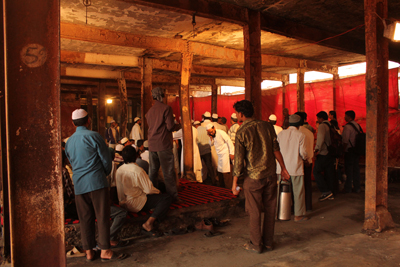
The priests from Muslim educational institutions all over the city being served a meal after the reading of the Quran.


This was the part which had been damaged completely and can be seen in the previous post pictures as well.


Some of the vendors intermittently came in to participate in the Puja. In one side of the market building, business was going on as usual.


While the priests read, the chaiwallah looked on.


While the priests read, the newspaper reporters and the television channel photographers documented what went on. 


Life was getting back to normal on the day of the puja 


There was after the Quran reading, a Hindu priest performing a puja.


Was this the same market courtyard we had seen a week ago?

Tuesday, February 28, 2012

Russell Market after the fire

It was on the morning of 25th Feb 2012 that the fire caused severe destruction at the Russell market in Bangalore. As I stood in front of the Russell market two days after the fire, I saw that the outer façade had not been affected and did not show any external signs of damage. I entered the building and looked towards the popular dry fruit shops to the left, but they weren’t there. It was just a black space with people randomly walking about. One half of the market was functioning, in the other half, the shops and goods had been completely burnt down. I had read in the news article Bangalore’s Russell Market gutted in The Hindu that the fire was believed to have been caused by an electrical short circuit and that 174 shops had been damaged.

As I walked further down the market building, there were people cleaning up the debris – wooden poles that were charred, windows that were wrecked, plastic items that had melted into one blackened mass and objects that couldn’t be identified properly anymore. Some people cleared the debris, others stood there watching. The vendors said that the debris had to be cleared away so that life could go on. Some of them had lost goods worth more than a lakh of rupees since they had stocked up for the weekend when sales at Russell market were twice as much as on weekdays. They said they could not wait for the Municipal Corporation to clean up the mess since the Corporation might take 15 days to cart away the debris.

The vendors say that the BBMP - Bruhat Bengaluru Mahanagara Palike had suggested that this dilapidated and now damaged structure could be demolished completely so that a new shopping complex with basement parking could be built here. The vendors had decided that they would not vacate the premises since they did not want this heritage building to be brought down. Besides, they were not sure how long the Municipal Corporation would take to complete the work and whether the alternative location provided to the vendors in the meantime would be as good as this one. The vendors now planned to reconstruct the shops themselves in as little time as possible so that their business could continue.

There has been an on-going disagreement between the Vendors at Russell market and the Municipal Corporation about rent prices of shops inside the market building, about maintenance of the interior of the building and about garbage disposal. The vendors do not want to pay the rent that the Corporation thinks appropriate and the Corporation therefore has refrained from maintaining the market building or its surroundings. In an earlier blogpost Oral history at Russell market, I have included excerpts from interviews with the vendors and think that understanding their beliefs and their doubts could lead to working out a better urban regeneration plan for the Russell market precinct which may or may not entirely meet their demands but can be implemented successfully if the communication between the stakeholders and the Government improves considerably.

It is seldom that vendors in a fruit and vegetable market in any part of the world have had their demands met by the City corporation and not often that the City knows how to overcome its own difficulties of managing a market in an expanding Inner city core. I wrote about this earlier at Planning for the transition. The vendors’ want better amenities within the market building so that they can have a more efficient workplace as well as better parking facilities so that they do not lose the customer base they have built up over many years. In a city core that gets denser with an increase in population, increase in commercial activity and an increase in traffic congestion, this is usually difficult to solve.

In a Market redevelopment project, a design solution that takes into consideration the functioning of the entire urban precinct enveloping the site of the fruit and vegetable market building may be more appropriate than focusing on a site-specific architectural solution. A bazaar in India usually originates with a market building and grows into several intersecting streets lined with shops and eventually develops into an entire market precinct. For instance, we have the Crawford market in Bombay, Manek chowk in Ahmedabad, the Lad bazaar in Hyderabad and the Russell market in Bangalore. These are the Inner city cores where formal retail and informal retail grow simultaneously and must both be understood so that we can generate an integrated development plan. I wrote earlier about The Informal Economy and Urban space, a post that focuses on the wholesale tomato market outside the Russell market, a temporal marketplace that operates for an intense two hours every morning.

Whilst the fire at Russell market will require that the inside of the building be given adequate attention so that livelihoods can be resurrected at the earliest, there have been issues that affect the vendors and the public that lie outside of the market. One of the key questions will be how can we resolve the parking problems which are currently affecting the business of the shopowners both inside and outside the market building as well as making it difficult for the traffic to manoeuvre its way through the increasing congestion on the roads? Will it help to survey the adequacy of the Parking facility built above the Shivaji Nagar bus stand and the roads leading up to it? Traffic congestion is a problem that the entire city of Bangalore is currently battling with. An article in The Hindu, Why do we find ourselves in such a jam today? discusses the vehicular growth in Bangalore over the last ten years, the draft Parking Policy and possible solutions for improving the movement of traffic on the roads.

The second key question will be how can the Municipal Corporation generate revenue so that it can maintain the market and its surroundings better, without the city having to lose a traditional bazaar and a heritage building? With heritage market buildings, it is attractive for the Municipal Corporation to take acquisition of the land and find a more lucrative use for it since the price of the land is higher than the value of the building that sits on it. The need to conserve architectural heritage is difficult to fathom in the strife for generating revenue for the city and improving its infrastructure. For the phenomenal numbers of people that live in every Indian city, it is amazing how cities work here. However, for citizens to appreciate the efforts of the government, perhaps the city needs to function even more efficiently or the government must be able to communicate to its people why it is unable to do better and how the public must contribute.

Related posts:

Friday, December 23, 2011

The Informal Economy & Urban Space

In the marketplace, the intriguing part for me has been the creative ways that wholesale and retail vendors use as they conduct their business. They work in conditions where resources are not plentiful enough and optimum use must be made of whatever is available bringing down the price of the product to what is "affordable" and taking the profits to a daily income that is “reasonable”.

The urban selling space therefore borrows from the public spaces of the city where no price or a small price can reduce or eliminate the overheads related to rent/ownership of a space. Within this space, there are innovative ways that vendors use on an everyday basis to sell better - a balancing act - to meet the expectations of their customers (who's footpath they borrow), the formal shopowners (who's visibility they infringe upon), the municipal officials (who's planning regulations are not adhered to) and the Police (who's law and order situation is made more complex and therefore can result in an extra cost for the vendor).

This post is about the wholesale tomato market that takes place every day outside the Russell market building at Shivajinagar in Bangalore. It is about 6.30 in the morning and the time of the year is mid November. The stretch of road between the Russell market building and the St.Mary’s Basilica which is the site of the tomato market has groups of vendors, people moving from one group of vendors to another; there are auctions either just completed or on-going; there are several tempos and auto-rickshaws that are picking up the sacks of tomatoes that have been bought and need to be taken away from this site to its next destination in the chain of tomato supply for the city.

It is one of the sites where the Informal economy and the City hold their auctions for agricultural produce and for urban space. Here is where vendors and buyers negotiate a price for a daily commodity such as tomatoes and where vendors and municipal authorities negotiate a price for yet another daily commodity – the urban spaces of the city.

1  The Noronha road, the St.Mary’s Basilica, the Russell market and the rest of the city all come together – a piecing together of urban components that people live in, pray in and do their buying and selling in. 

2  In the Google Earth map of Shivajinagar, the site of the tomato market on Noronha road is highlighted in orange, its edges undefined. One can also see the centrality of the Russell market in the urban fabric of Bangalore. There is the St.Mary’s Basilica at the south end and the Market square at the north end.

3  The Russell market building is almost like the “edge” in a drawing or a map. There is the entire stretch of road which is covered, completely covered with people walking, people transacting business, people loading and unloading the trucks with plastic crates or jute sacks filled with tomatoes. 

4  It’s a morning of good sales for the tomato vendor who occupies a permanent place in a “temporary” location just outside the Russell market building but within its compound walls. 

5  One of the vegetable vendors inside the Russell market, Naseem, points out that the tomato vendors have been doing this business on the streets for many years now and have taken away the business of the vendors who are inside the market building. Some vendors who have shops inside the Russell market, also put up their produce for sale on the streets every morning. “But, we don’t do that” he said. “After all, one has to be a little dignified.”

6  The nature of the urban fabric that surrounds this urban space and its informal economy – a mixed use neighbourhood with commercial and residential interlacing with each other

7  More than anything else, it is this mass of people which seems to be the most predominant element in the urban landscape 

8 There are big players and there are small players – some operate as individual vendors and for some it is a family-operated business with several members participating actively every morning in deciding on the right price in an auction.

9 The sale does not end here. The tomatoes travel to another part of the city on a push cart or a hand cart and enter into yet another piece of negotiation. Now, in another part of the city, that street begins to participate in its own negotiation of urban space for the day.

10  I ask myself as I look at this informal but “everyday” tomato market: All seems to be going on seemlessly. How much change do we want? How much better can our city be? And, how can it be better than what it now is?

This post has featured in the DNA - Daily News & Analysis on Jan 2, 2012 and this is the link at Around the Blog

Read about:
a Street Bazaar & the CITY
a Street corner in Mumbai

Friday, July 22, 2011

Oral History at Russell Market

Recently, we’ve have been talking to street vendors and shop owners at Russell market in Bangalore. I include below excerpts from an interview:


“In the Russell market of old, the population was much less. There were many foreigners. You can say that one could buy just about anything here. There was nothing that was not available here. Now, there are many changes, there are traffic problems, there are parking problems. The maintenance of the market is not proper." 

We found that most of the older vendors have pleasant memories of the market and their day-to-day business. There was a substantial part of the clientele that was Anglo-Indian. Many of these were people who lived in Shivajinagar, the residential neighbourhood that envelops the Russell market and the 'Cantonment area' nearby. The vendors at Russell market speak with great pride about the wide variety of exotic fruits and vegetables you could buy here, some of which were imported from outside the country, especially during Christmas, when there was a 2-day Exhibition at the market, with vendors displaying some of the most attractive agricultural produce, and displays that competed for prizes at the Market Exhibition.

"Today, there are no officers in-charge like before. There used to be an office upstairs on the first floor of the market. There were watchmen all around the market building. There is nobody looking after this place now. This is a Corporation market. Earlier, when there were good officers, the market was maintained well. It was frequented by foreigners. Today, foreigners are afraid to come here. Maintenance is not proper. The shops are not proper. There is not a good enough accessway. They are giving our market a bad reputation"

Many of the vendors express the lack of support from the Municipal Corporation in terms of infrastructure upgradation and maintenance. However, we learnt that the vendors who have shops inside the market building pay a monthly rent of only Rs.200. The BBMP or municipality is reluctant to upgrade since their monthly revenue from the market is quite low and they are unable to get the vendors to pay a higher rent.

"Earlier, our business was so good. The people who now come to Russell market are fewer in number. Today, the market caters mainly to hotels and retail business has totally flopped. Parking has been a big problem. Even today, the vegetables you can get here, you will not get anywhere, the rare varieties. The customers don’t have parking space. Nobody can bring foreigners here to show them around."

Russell market is located at one end of Noronha road with the historic St.Mary's Basilica at its other end. It is a beautiful tree-lined avenue and one can imagine how beautiful the street would have been without the traffic congestion and lack of maintenance one finds here today. There have been attempts to resolve the parking problems but these haven't been entirely successful. One of the options has been to build a parking facility above the Shivaji Nagar Bus Stand in the vicinity. According to a few of the shopowners, this facility is not fully utilised since many visitors to Russell market are unaware of its existence. Secondly, a one-way access on the linkage between Shivaji Nagar Bus stand and Russell market requires cars to take a much longer detour before they can reach the Parking facility and many people opt for parking in front of the shops, adding to the congestion here.

"In the old days, I would wake up at four in the morning to come to the market. From 4am once our business started, until 10 am, we would not have the time to even have a cup of tea. That is how good our business was. We would eat our breakfast at 11am or 12 noon. After that, till 3 to 3.30 in the afternoon we would take a nap. Then, until 10pm, there would be so many people at the market. This was how it was about twenty years ago.”

These recollections of the vendors at Russell market were a way for us to recreate the bazaar in our minds. There is so little documentation available on our marketplaces that these oral history interviews become for us an important tool to understand the way in which bazaars work.

Interviewers : Rakshitha K.S. and Srishti Singh

Related Posts :
What is Russell Market
Urban Structure: City Market and Russell Market
How Green is my Bazaar
Marketplaces and Tourism

Tuesday, December 21, 2010

Marketplaces for Tourism

Sketch plan of existing Russell market precinct

It may be a good time for us to revitalise our traditional bazaars by developing a few bazaar zones as tourist destinations. In order for us to do this, we need to ask ourselves : How does one deploy cultural heritage as a marketing strategy for tourism and retail sectors just so that it heightens the sense of pride in traditional values? What will be the guidelines and incentives for land-owners to refurbish their shops in a bazaar? How can we conceptualise and implement a revitalisation plan of a bazaar that benefits all the stakeholders? What are the views of the tourists, residents, local visitors and the merchants who belong to the bazaar?

In Amsterdam, tourism is so much a part of the market. There are dutch souvenirs everywhere. There are Tulip bulbs packed in delft blue and wooden tulips on sale for tourists. Flower markets in India are primarily for the domestic market. International tourists visiting India do often visit our flower markets, but the markets are not designed to serve them as tourists.

In the Indian flower market, most of the flowers are loose flowers sold in kilos for temple offerings or garlands for wedding ceremonies, garlands for funerals and garlands for political events!

In Amsterdam, the architecture, the canals, the dutch bicycles and the tulips make an interesting tour for anyone who loves the bazaar.


This blogpost is part of an article I wrote that was recently published in Architecture+Design - an Indian journal of architecture. To READ MORE refer to the A+D Vol XXVII no. 12 December 2010 issue


Related Posts :
What is Russell Market
How Green is my Bazaar

Wednesday, February 25, 2009

Urban structure – City Market and Russell Market

To begin a thought process on the regeneration of the Russell Market heritage precinct, i look at the history of the market and the history of its neighbourhood. Today, it is also possible for us to easily access a map of the area using Google Earth. One notices in the image included below that the red spot, which represents Russell market is at the centre of a dense urban fabric of old bangalore. There are several main roads that radially converge to the Market Square. This so emphatically confirms the importance of this area in the way the city grew.

The picture shown above is of the Russell Market Square in ShivajiNagar, Bangalore. The photograph was taken in February 2009


V.L.S.Prakasa Rao & Vinod K.Tewari describe the development of the City Market and the Russell Market in ‘The Ecological Structure of Bangalore City’*

"The Fort near the City Market on the west, and the Barracks near the Ulsoor Tank on the east, were the two foundations of Bangalore City. The two kernels of the city, situated only 4 miles apart, were founded with a time-lag of more than two and a half centuries-the Fort built in 1537 and the British Garrison and Barracks established in 1809. The neighbourhood of the Fort and the neighbourhood of the Ulsoor Tank developed under two different raisons d’etre. The defensive strong point apart, the Fort city was oriented to the philosophy of a city and temple builder, an agriculturist turned warrior, under whose patronage developed a township of wholesale and retail traders, and of highly skilled artisans particularly families of cotton weavers (Hasan 1970, Rao 1930)

In contrast to this, the neighbourhood of the Ulsoor Tank was developed to cater to the requirements of the British troops and British officers who were pulled out of Srirangapatnam and settled near the tank. Thus, a military cantonment developed along with a civilian settlement of mainly retail traders and service classes adjoining the Ulsoor village. While the Fort neighbourhood developed as a typical native town with its bazaar, traders and artisans, the Ulsoor neighbourhood developed as a cantonment with its artillery and cavalry barracks, parade ground, infantry road, the Mall, fine and spacious bungalows, bars and night clubs.

Both the nuclei expanded; the Fort neighbourhood expanded east, north and south, and the Ulsoor neighbourhood expanded west, north and south, invading the open spaces and fertile agricultural lands. With the development of the Russell market and westward expansion of the cantonment, the nucleus of the west shifted to Russell market locality, while the development of the City market near the Fort contributed to further intensification of the growing nucleus of the west. The east-west zonation certainly had its intermixing and integrating social-cultural elements in the two nuclei : temples, churches and mosques near both the City market and the Russell Market. Even the street names such as Dharmaraya Koil Street and Meenakshi Koil Street in the predominantly Muslim and Christian areas near the Russell Market, and Sultanpet near the City Market, a predominantly Hindu area, only echo the co-existence of the different religious communities."

One finds a similar pattern of urban development in Georgetown, an old historic settlement in Madras, now Chennai. There is the Fort St.George nearby whose establishment soon generated a neighbourhood of retail traders and also artisans who initially came to Madras on short visits and later settled here to support the growing town. The history of Indian city centers seems to reflect a marked connection between artisan settlements, a central market and a religious establishment, and going back a little further, a connection perhaps to a nearby fortified British settlement or Fort, that the artisans, the local traders and the priest community initially served.

The above picture shows a typical street in Georgetown, the photograph was taken in January 2008

*Tewari, Vinod K., Indian Cities-Ecological Perspectives, Concept Publishing Company, New Delhi, 1986


Related Posts :
What is Russell Market
How Green is my Bazaar
Marketplaces and Tourism
The Informal Economy and Urban space
Monday, February 16, 2009

what is Russell market?


There is more than just a building that makes up the 'Russell Market' environment. There is the "market square" which is the large open space and a meeting point of roads. There is the St.Mary's Basilica and the Richard's square along the same road.

My first visit to the Russell Market was the 'Heritage walk' organised here by INTACH - a non-profit organisation - the Indian National Trust for Architectural and Cultural Heritage. Deepa Mohan describes the walk in her article for Citizen Matters : ShivajiNagar Reintroduced

Related Posts :
How Green is my Bazaar
Marketplaces and Tourism
Urban Structure: City Market and Russell Market
The Informal Economy and Urban space