Showing posts with label Indian shop. Show all posts

Friday, January 06, 2012

What is Chai

And, why is the chai so much a part of our lives? In India, we believe that time is cyclic and in the many years we live before we are reborn again, the chai is at the core of our existence. It is the cup of chai (tea) that helps us mark time in our homes, in our streets, in our marketplaces. Every home offers its guest a cup of tea. Every street corner offers its visitors a glass of chai. In the marketplace, the chai creates the social space that people need as an introspection, an interaction or a sharing of experiences.

The Chai glass: in a Street in Udaipur

The tea or “chai” has a special place in the homes of North Indians with its range of flavours to choose from. There is the Adrak-ki-chai (ginger tea), the Elaichi-chai (cardamom tea), the Dalchini-chai (cinnamon tea) or the Pudina-chai (mint tea) and with every cup, you add to your memories of a morning of reflection, an afternoon of family decisions or an evening of sharing with a friend. As I look closely at tea stalls in the streets and bazaars of Ahmedabad, Udaipur or Delhi, I realise that there are so many different ways in which people gather in public spaces "for a cup of chai".

As people participate in the buying and selling of goods in the Bazaar or Marketplace, they exercise control over the space in which they are situated and which surrounds them. For vendors, this control is the ability to transform some part of the bazaar environment to support their economic activity and sometimes their social needs as well. It is this transformation process that the chai stall seems to symbolise as it becomes the point of departure for economic and social exchanges in the marketplace.

1. a Shopowner sipping his morning cup of tea as the street bazaar begins to ready itself for the day’s customers

2. a Chai stall in Ahmedabad that manages its operations on a push-cart with its customers standing around the cart and exchanging the morning news or discussing the day’s work.

3. The functional space requirement for the making of the tea is quite minimal and the tea vendor needs a supply of water for the tea and for the washing to fulfill his operations at the marketplace.
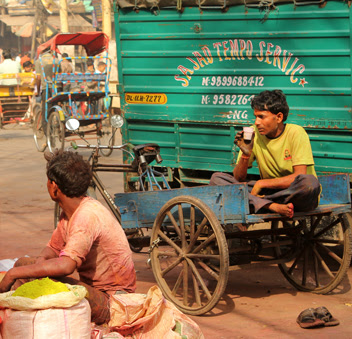
4. While you can have a cup of chai as a shopper in the bazaar, the chai vendor also serves his fellow workers. At Sadar Bazaar in Delhi, the cycle rickshaw wallah, the auto rickshaw wallah and the tempo driver, all of whom bring the agricultural produce and other goods to the market in the early hours of the morning have their tea served to where they choose to rest. 

5. The chai stall in the town of Patan in Gujarat has a generous sitting place that belongs to the street. The tea seller uses a public space for private consumption and this borrowed space becomes a place of social exchange that he offers his regular customers. 

6. Sketch Plan of Chai stall in Patan: The tea vendor is part of a layering process that has spatial elements – those that mark his own territory and those that circumvent his territory

7. In Gujarat as in other parts of India, you can buy yourself adrak chai on the streets and you may have a choice of a plastic cup or a ceramic cup and saucer to suit your own levels of hygiene and nostalgia

I first began to think about the place of Chai in Urban spaces when I had the chance to listen to Philip Lutgendorf present his research work at Dakshinachitra on the Indian Tea. Here is a link to: Chai Why? – The Triumph of Tea in India

And, this is an interesting blog on the Irani cafes in Mumbai: http://www.iranichaimumbai.com/

Read about:
The Golla wallah
The Informal Economy & Urban space
Peanut festival in Bangalore
The Pani Puri wallah

Sunday, August 15, 2010

Fancy Stores

The Fancy stores in India are the places where women buy their glass bangles, their bindis, their kajal, their mehndi and their imitation jewellery amongst many other things. Some of the shops that are more Indian in their goods or their manner of exchange include the Kirana shop, the Paan shop, the Iyengar bakery and the Fancy stores. 


In one afternoon, I go in and out of several of these Fancy stores at Gandhi Bazaar in Bangalore – always buying something at each store. Just so irresistible!! One of the most common items for sale of course are the glass bangles. These are traditionally worn by many Indian women everyday. The glass bangles come in plain colours as well as with shiny gold spots that are so apt to be worn with a silk saree or an embroidered zari salwar kameez. They come in different sizes and the shopkeeper often helps with slipping them through the delicate wrists of his women customers as they try the size or the design.

Firozabad, in Agra district in Uttar Pradesh has the largest number of small scale glass bangle making units in the country. This town is sometimes referred to as Suhag nagri since it provides all the bangles, kadas, kangans and other items of suhagins (married women). It would be interesting to know how these bangles are distributed from this central glass bangle manufacturing town to every Fancy store in India and to all the kiosks in street bazaars.

These days, one can also find in the Fancy stores – the white and red plastic bangles that are worn customarily by Bengali women but became quite fashionable at weddings in cities all over the country as young women moved from adorning themselves with objects of cultural significance to objects of pure aesthetic. This was an aesthetic that was modern and in its abstraction gave colour importance over motifs and symbols.

The shopfront is often a glass showcase completely filled with colourful glass bangles, sometimes a mannequin of a woman adorned with many of the items that the shop offers for sale. This is one kind of an ‘indian shop’ because it has fashion accessories that are so much a part of an Indian woman’s attire and sense of propriety. 


The Kajal or Kohl is a home-made eyeliner which was traditionally prepared using a mixture of castor oil, sandalwood paste and ghee. It was originally used for preventing infection in the eyes. Today, you can buy kajal made in local small-scale manufacturing units or the branded ones such as Lakme or Himalaya.

Mehndi or Henna is a powder made from the leaves of a shrub, used as a conditioner and for colouring the hair. It is also used extensively during weddings to adorn the hands and feet of the bride and all her women friends and family with coloured floral and geometric designs.

The Bindi is worn on the forehead as an auspicious symbol and many varieties of Bindis are available at the Fancy stores. The variety in Bindis begins with the red powder or kumkum to the plain red bindi stick-ons to the fancier bindis with gold and silver designs.

This kind of shop also sells imitation jewellery. There are innumerable gold and silver jewellery shops at the main markets in any city. But, if you need to buy something not so expensive for a smaller function or for your teenage daughter’s cultural evening at school, the Fancy stores is where you go to.

The fancy stores mostly have a standard L-shaped counter or sometimes a C-shaped counter if it is a shop of larger area. This counter has a glass top because beneath the entire counter are displayed earrings and necklaces to make the choosing so much easier and of course, these glass displays do not fail to attract the lady customers to things they had not even intended to buy.

Shopping at the Fancy stores has a good percentage of ‘impulse purchases’. Behind the glass sales counters are the salesmen who help you try out the bangles or simply open and close boxes for you that contain endless varieties of jewellery or bangles. There are shelves that cover the entire wall length with perfumes and other cosmetics. There are mirrors fixed at a few places in the shop that allow you to try out a piece of jewellery to see how it looks on you before you finalise your buy.

My first stop in Gandhi Bazaar was the Mahila Bangle stores. This was the largest Fancy store on D.V.G.Road. The prices were higher compared to the smaller shops. One dozen glass bangles that sold for Rs.12 elsewhere were priced at Rs.15 here. But the variety here was phenomenal. They had three floors of goods categorized into Cosmetics at ‘O’ level. Level One had “All Bangle varieties, Chains/Haras/Malas, Necklace sets, Kumkum/Bindis, Ear tops, Hair pins, Baby clips” and Level Two had “Bridal Jewellery and Jewellery kits” for hire.

After having seen this all encompassing range of bangles and jewellery, I walk into ‘UmaShankar Fancy Bangle stores’. This is one of the smallest fancy stores here. It’s a simple shop, about 8ft.x 12ft in size and seems a bit dark after having been to the glitzy well-lit Mahila stores next door. There are only two salespeople here and seem more than sufficient for a small shop. They are both busy arranging things in their display cases, as I walk in but immediately pay attention as I start to show interest in some bangles. The goods are simply arranged. Necklaces and earrings just hang on simple boards against the wall. The prices are just normal, what one pays at the local fancy store in one’s own neighbourhood. The Saleswoman is also the Cashier and transactions take place quietly.

My next stop is ‘Patel Bangle store and gift articles’. It has some glass bangles on display loosely kept on a stool outside the shop and I’m curious to see how this one will be. There is a little boy whom I first encounter and decide to play my role of “interested buyer”. I ask for this colour and that colour. I am now using the Bangle shop parlance and asking for size 2-6 with some confidence. It gets them interested straightaway, implying that I must be a seasoned bangle buyer to give them the size needed without being asked.

This young boy is a good salesperson and is continuously making conversation to guage what I want. His sales pitch goes “These plain colours are for everyday use, which you would need anyway. Why not try this bangle set for festive occasions? It looks good…” He is talking non-stop in a completely jovial manner, making the looking around so much easier. I finalise the purchases. I then ask if I can take a few pictures. He smiles again. “Well, if you include me in your pictures, you sure can!” I gladly take a picture with Deepak giving me a natural pose.

Deepak's shop is deeper compared to the UmaShankar store. It is a shop that belongs to Marwari shopowners. They sell bangles but also sell Facial Scrubs, Massage gels, Lotions, Oils, Henna, Hair dyes and Products for skin and hair care. Everything that you would need in Cosmetic care is available here.

My final stop for the day is the Shringar Fancy centre. This one is a bit further down on H.B.Samaja road. What you find here which is not in the other stores are dance dresses for hire. In addition to that, it has cosmetics, hair dryers, curling irons and so on at the ground level and a wide range of glass/metal bangles and hair clips on the first level.

Is Bargaining a part of a Fancy store? Not really. Prices are usually fixed. You buy glass bangles at a given rate for a dozen. You usually cannot buy less than a dozen. Prices of mehndi packets and kajal are fixed too. It has a Maximum Retail Price (MRP) printed on it. These are not products made by the shopowner. Every item he sells is sourced from a manufacturer located elsewhere. 


And, where are the Fancy stores usually located? You invariably find one in each neighbourhood or the next main street junction, since these are small shops and meant to service small needs of daily dressing up. However, in the main shopping areas of the city, you often find more than one fancy store along a single street. For instance, in Bangalore, in the Gandhi Bazaar area, along D.V.G. Road, there are several fancy stores in just one street. It increases your chances of getting exactly what you are looking for!

The fancy store in the local neighbourhood is for picking up those items that cannot wait a few weeks. But, Gandhi Bazaar is where you go to when you have at least a whole afternoon to spare so that you can also buy the matching blouse for your new saree or the puja items that you have been meaning to pick up for the ganesh or vinayaka ceremony at your home, with the Ganesha festival drawing closer and closer and decoration of self and the gods simultaneously gaining importance.

I have posted earlier on the Indian shop which can be a collective memory of times past and an interesting part of the daily life in India.


Read about :
Dadar Flower Market, Mumbai
Antique market, Mumbai
Varkala, Kerala
Gandhi Bazaar, Bangalore

Friday, February 26, 2010

Indian shop - 2

There has been a profound and rapid change in how commerce has evolved in India in the last twenty-five years. The growth of the retail industry has created new opportunities for the discerning Indian entrepreneur. The livelihood scenario that belongs to the Indian shop has changed from artisans who crafted and marketed brass pots to traders who sell plastic buckets and sintex tanks. Today, one finds traditional shopping environments that continue to sell fruits, vegetables and puja items as well as the modern shopping environments, where multi-national companies sell brands that compete in the international fashion market.

And less evident to consumers, shopping environments today present a clearer demarcation of wholesale and retail spaces, quite different from how it was in the old bazaars. This has created efficiencies in the way a modern market economy understands them, through ideas of ‘division of labour’, ‘specialisation’, and so on, but it has also expanded the distance between the people whose lives and livelihoods are scattered along the supply chain. Equally noteworthy is another kind of social distance - the segregation of residences and segregation of purchase environments that is now becoming the norm. Whereas rich and poor alike lived and shopped in the same marketplaces in the past, increasingly the modern retail environment is premised upon distinguishing between the two.

Against this backdrop, the Indian shop can be a collective memory of times past, and also an expression of the aspirations of today. Within bazaars and malls, one can look for and trace the cultural, sociological and aesthetic forms that are still evident in the patterns of commerce and trade, and the changes they are undergoing. One searches for a modern perspective for the architectural design of Indian shopping environments – the bazaars and the malls. The shop is a place of private consumption, and has been so for long. But, what used to be ‘private consumption in public spaces’ is increasingly giving way to ‘private consumption in private spaces’.

Thursday, February 18, 2010

Indian shop

As the many faces of the Indian shop are revealed, one discovers a little more about the economics of trade as well as the social and cultural values of the Indian society. In previous blogposts, I have shared observations on the Fruit and Vegetable market, the Marketplace, the Fish market, the Street bazaar, the Informal sector, the Bakery and the Canal bazaar. This blog also includes notes on shopping environments such as the Weekly market, the Flower market, a Spice bazaar, the Tibetan Bazaar in Kerala and the Mall.

What is the difference between Lad Bazaar in Hyderabad and the Forum Mall in Bangalore? What are the exchange systems or price mechanisms of antique shops in Chor Bazaar in Mumbai that can be compared to the Malaysian Imported Furniture showrooms in Chennai? Is there more competition among sellers in Palika Bazaar in Delhi, than in a Satellite road mall in Ahmedabad?

Will the modern Big Bazaar's “Bargain offers” entice indians enough to forego their ritual of bargaining in a street bazaar? What does the experience of shopping in Manek chowk in Ahmedabad mean to a gujarati family? Why does Connaught Place in Delhi have popular eateries that cater to young indians with western tastes? Why does Ashram road in Ahmedabad have a blend of old and new as it hosts a Pizza outlet at one road junction and makes equally good business with the small bhel-puri stalls that dot the footpath?