Showing posts with label Vegetable market. Show all posts

Tuesday, March 06, 2012

The Riddle of Russell market

There are two riddle questions that seem to come out of the fire that damaged the Russell market ten days ago.

1. What really caused the fire – conflict or neglect? 
I read in The Hindu on 25 Feb 2012 Bangalore's Russell market gutted that it was an electrical short circuit that caused the fire. But, the vendors say it is a big plan of the government to get them onto the footpath and out of the 2-acre property. One vendor I spoke to said “How could an electrical short circuit spread so much and destroy such a large part of the market in a time period of half an hour?”. Another vendor insisted on explaining that “The Fire Department was also with THEM. They were dousing water with high pressure pipes onto the cast-iron columns instead of onto the wood that was on fire. You see, that is why the cast-iron pillars are now bent, whilst the fire continued to spread and cause damage”. Speaking to the vendors six months ago, I had learnt that the rent paid by each of the shopowners inside the market building is Rs.200 per month. They do not want to pay more. The municipal corporation has been refraining from proper maintenance as a result. Why have the vendors not agreed to paying more? Why has the government kept away?

2. Will the government eventually demolish the market building to build a mall?
The government has been denying having any plans for acquisition of the Russell market property to build a mall here. Municipal Commissioner M K Shankarlinge Gowda  has said “There are no plans before the BBMP to demolish the existing structure. Besides, it is not a suitable place to build a shopping complex” (Source: IBN Bangalore)

But, the vendors have formed a new association last week, where the fruit vendors, the vegetable vendors and other small vendor groups can collectively form a stronger force that the government cannot displace. They had a puja on last Thursday morning which received some media attention. I learnt from the Secretary of the Vendors association that they were so determined now to hold a grand Exhibition in December (it was an old tradition during the British times) at the Russell market and that there was nothing the government could do to take their market away from them.

It’s difficult to know what is true, but important nevertheless that we find the right answers because in all of this conflict and neglect, we almost LOST a historic market of the city. If perceptions need to change, how do we do that? If perception IS reality, then, how do we effect change?
-------
I am posting here some photographs from last week's visit to Russell market the morning of the Puja. It was a complete change from the days immediately after the fire, pictures of which are at:
Russell market after the fire

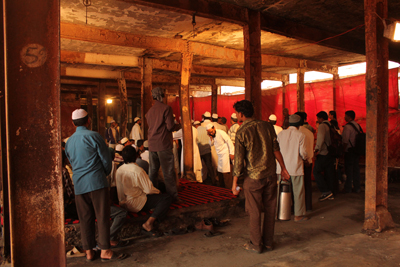
The main entrance of the Russell market on 1st March - the day of the Puja


The priests from Muslim educational institutions all over the city being served a meal after the reading of the Quran.


This was the part which had been damaged completely and can be seen in the previous post pictures as well.


Some of the vendors intermittently came in to participate in the Puja. In one side of the market building, business was going on as usual.


While the priests read, the chaiwallah looked on.


While the priests read, the newspaper reporters and the television channel photographers documented what went on. 


Life was getting back to normal on the day of the puja 


There was after the Quran reading, a Hindu priest performing a puja.


Was this the same market courtyard we had seen a week ago?

Tuesday, February 28, 2012

Russell Market after the fire

It was on the morning of 25th Feb 2012 that the fire caused severe destruction at the Russell market in Bangalore. As I stood in front of the Russell market two days after the fire, I saw that the outer façade had not been affected and did not show any external signs of damage. I entered the building and looked towards the popular dry fruit shops to the left, but they weren’t there. It was just a black space with people randomly walking about. One half of the market was functioning, in the other half, the shops and goods had been completely burnt down. I had read in the news article Bangalore’s Russell Market gutted in The Hindu that the fire was believed to have been caused by an electrical short circuit and that 174 shops had been damaged.

As I walked further down the market building, there were people cleaning up the debris – wooden poles that were charred, windows that were wrecked, plastic items that had melted into one blackened mass and objects that couldn’t be identified properly anymore. Some people cleared the debris, others stood there watching. The vendors said that the debris had to be cleared away so that life could go on. Some of them had lost goods worth more than a lakh of rupees since they had stocked up for the weekend when sales at Russell market were twice as much as on weekdays. They said they could not wait for the Municipal Corporation to clean up the mess since the Corporation might take 15 days to cart away the debris.

The vendors say that the BBMP - Bruhat Bengaluru Mahanagara Palike had suggested that this dilapidated and now damaged structure could be demolished completely so that a new shopping complex with basement parking could be built here. The vendors had decided that they would not vacate the premises since they did not want this heritage building to be brought down. Besides, they were not sure how long the Municipal Corporation would take to complete the work and whether the alternative location provided to the vendors in the meantime would be as good as this one. The vendors now planned to reconstruct the shops themselves in as little time as possible so that their business could continue.

There has been an on-going disagreement between the Vendors at Russell market and the Municipal Corporation about rent prices of shops inside the market building, about maintenance of the interior of the building and about garbage disposal. The vendors do not want to pay the rent that the Corporation thinks appropriate and the Corporation therefore has refrained from maintaining the market building or its surroundings. In an earlier blogpost Oral history at Russell market, I have included excerpts from interviews with the vendors and think that understanding their beliefs and their doubts could lead to working out a better urban regeneration plan for the Russell market precinct which may or may not entirely meet their demands but can be implemented successfully if the communication between the stakeholders and the Government improves considerably.

It is seldom that vendors in a fruit and vegetable market in any part of the world have had their demands met by the City corporation and not often that the City knows how to overcome its own difficulties of managing a market in an expanding Inner city core. I wrote about this earlier at Planning for the transition. The vendors’ want better amenities within the market building so that they can have a more efficient workplace as well as better parking facilities so that they do not lose the customer base they have built up over many years. In a city core that gets denser with an increase in population, increase in commercial activity and an increase in traffic congestion, this is usually difficult to solve.

In a Market redevelopment project, a design solution that takes into consideration the functioning of the entire urban precinct enveloping the site of the fruit and vegetable market building may be more appropriate than focusing on a site-specific architectural solution. A bazaar in India usually originates with a market building and grows into several intersecting streets lined with shops and eventually develops into an entire market precinct. For instance, we have the Crawford market in Bombay, Manek chowk in Ahmedabad, the Lad bazaar in Hyderabad and the Russell market in Bangalore. These are the Inner city cores where formal retail and informal retail grow simultaneously and must both be understood so that we can generate an integrated development plan. I wrote earlier about The Informal Economy and Urban space, a post that focuses on the wholesale tomato market outside the Russell market, a temporal marketplace that operates for an intense two hours every morning.

Whilst the fire at Russell market will require that the inside of the building be given adequate attention so that livelihoods can be resurrected at the earliest, there have been issues that affect the vendors and the public that lie outside of the market. One of the key questions will be how can we resolve the parking problems which are currently affecting the business of the shopowners both inside and outside the market building as well as making it difficult for the traffic to manoeuvre its way through the increasing congestion on the roads? Will it help to survey the adequacy of the Parking facility built above the Shivaji Nagar bus stand and the roads leading up to it? Traffic congestion is a problem that the entire city of Bangalore is currently battling with. An article in The Hindu, Why do we find ourselves in such a jam today? discusses the vehicular growth in Bangalore over the last ten years, the draft Parking Policy and possible solutions for improving the movement of traffic on the roads.

The second key question will be how can the Municipal Corporation generate revenue so that it can maintain the market and its surroundings better, without the city having to lose a traditional bazaar and a heritage building? With heritage market buildings, it is attractive for the Municipal Corporation to take acquisition of the land and find a more lucrative use for it since the price of the land is higher than the value of the building that sits on it. The need to conserve architectural heritage is difficult to fathom in the strife for generating revenue for the city and improving its infrastructure. For the phenomenal numbers of people that live in every Indian city, it is amazing how cities work here. However, for citizens to appreciate the efforts of the government, perhaps the city needs to function even more efficiently or the government must be able to communicate to its people why it is unable to do better and how the public must contribute.

Related posts:

Monday, February 16, 2009

what is Russell market?


There is more than just a building that makes up the 'Russell Market' environment. There is the "market square" which is the large open space and a meeting point of roads. There is the St.Mary's Basilica and the Richard's square along the same road.

My first visit to the Russell Market was the 'Heritage walk' organised here by INTACH - a non-profit organisation - the Indian National Trust for Architectural and Cultural Heritage. Deepa Mohan describes the walk in her article for Citizen Matters : ShivajiNagar Reintroduced

Related Posts :
How Green is my Bazaar
Marketplaces and Tourism
Urban Structure: City Market and Russell Market
The Informal Economy and Urban space

Tuesday, December 19, 2006

Fruit & Vegetable market

When one experiences the markets in India, walks through them, learns about their history, one begins to gather what they have in common. The nucleus has always been the vegetable and fruit market and the streets surrounding it that have developed to make a larger bazaar. Commercial areas in our towns and cities have all grown around the vegetable and fruit bazaar because this was a place where everyone in the town or city came everyday.

The marketplace in India has always been a dynamic environment. It has been an excuse to gather together for festivals, to exchange news, to enact dramas, to make public announcements. Every village, every town, every city in every country has markets. Sometimes they are small, sometimes they are large.

When one looks at Bazaars in
India, one finds that :
Markets in
India are influenced by the local cultures, behavioural patterns of the people and social customs. Art is an integral part of the Bazaar. The principles that govern the making of markets remain the same inspite of the diversity in the different bazaars of India

Is it possible to study this aesthetic and to recreate it once again for the cities of India? In the urban areas markets are built by the Municipal Corporations with better infrastructure but they sometimes lack local flavour and the vigour of the lives of the Indian people. There is much funding being directed to build markets all over the country. An analysis of the life within a bazaar and an understanding of how markets evolve over time becomes essential. Here is a link to : Fruit and Vegetable Marketing and its Efficiency in India - a study of wholesale markets in Ahmedabad