Showing posts with label Delhi. Show all posts

Friday, January 06, 2012

What is Chai

And, why is the chai so much a part of our lives? In India, we believe that time is cyclic and in the many years we live before we are reborn again, the chai is at the core of our existence. It is the cup of chai (tea) that helps us mark time in our homes, in our streets, in our marketplaces. Every home offers its guest a cup of tea. Every street corner offers its visitors a glass of chai. In the marketplace, the chai creates the social space that people need as an introspection, an interaction or a sharing of experiences.

The Chai glass: in a Street in Udaipur

The tea or “chai” has a special place in the homes of North Indians with its range of flavours to choose from. There is the Adrak-ki-chai (ginger tea), the Elaichi-chai (cardamom tea), the Dalchini-chai (cinnamon tea) or the Pudina-chai (mint tea) and with every cup, you add to your memories of a morning of reflection, an afternoon of family decisions or an evening of sharing with a friend. As I look closely at tea stalls in the streets and bazaars of Ahmedabad, Udaipur or Delhi, I realise that there are so many different ways in which people gather in public spaces "for a cup of chai".

As people participate in the buying and selling of goods in the Bazaar or Marketplace, they exercise control over the space in which they are situated and which surrounds them. For vendors, this control is the ability to transform some part of the bazaar environment to support their economic activity and sometimes their social needs as well. It is this transformation process that the chai stall seems to symbolise as it becomes the point of departure for economic and social exchanges in the marketplace.

1. a Shopowner sipping his morning cup of tea as the street bazaar begins to ready itself for the day’s customers

2. a Chai stall in Ahmedabad that manages its operations on a push-cart with its customers standing around the cart and exchanging the morning news or discussing the day’s work.

3. The functional space requirement for the making of the tea is quite minimal and the tea vendor needs a supply of water for the tea and for the washing to fulfill his operations at the marketplace.
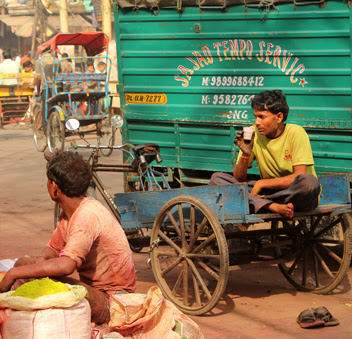
4. While you can have a cup of chai as a shopper in the bazaar, the chai vendor also serves his fellow workers. At Sadar Bazaar in Delhi, the cycle rickshaw wallah, the auto rickshaw wallah and the tempo driver, all of whom bring the agricultural produce and other goods to the market in the early hours of the morning have their tea served to where they choose to rest. 

5. The chai stall in the town of Patan in Gujarat has a generous sitting place that belongs to the street. The tea seller uses a public space for private consumption and this borrowed space becomes a place of social exchange that he offers his regular customers. 

6. Sketch Plan of Chai stall in Patan: The tea vendor is part of a layering process that has spatial elements – those that mark his own territory and those that circumvent his territory

7. In Gujarat as in other parts of India, you can buy yourself adrak chai on the streets and you may have a choice of a plastic cup or a ceramic cup and saucer to suit your own levels of hygiene and nostalgia

I first began to think about the place of Chai in Urban spaces when I had the chance to listen to Philip Lutgendorf present his research work at Dakshinachitra on the Indian Tea. Here is a link to: Chai Why? – The Triumph of Tea in India

And, this is an interesting blog on the Irani cafes in Mumbai: http://www.iranichaimumbai.com/

Read about:
The Golla wallah
The Informal Economy & Urban space
Peanut festival in Bangalore
The Pani Puri wallah

Thursday, April 28, 2011

The Marketplace: Lonely Planet Blog Carnival #23

The theme of this Blog carnival is a journey through a market or bazaar anywhere in the world. These thoughtful and exciting stories unravel life in the marketplace experienced at different times but all coming together here for you to transcend from wherever you are at this moment to where the Lonely Planet Travel bloggers think you would love to be!!

David Bennett of Quillcards tells us the story of the Changing Times In The Largest Indoor Market In Europe as he describes the Kirkgate Market in the center of Leeds in Yorkshire in the north of England.

“As long as I have known Kirkgate market it has been the province of ‘working class’ Leeds. Some people in Leeds never shop there, preferring to shop in more upmarket places. So to see Jamie Oliver’s Ministry of Food in Kirkgate market helps to bring about a paradigm shift in the way markets are seen.”

Jennifer Hattam of The Turkish Life recollects her experience at an Uzbek bazaar - the Chorsu bazaar area at Tashkent in Uzbekistan which she had noted down as a journal entry during her travel there in November 2004.

“We dipped our fingers to taste honey dripping from a knife and spices sold out of canvas sacks as nearby vendors sat and churned huge vats of a marshmallow-like substance and offered tastes to passers-by.”

Brandon of Freewheelings writes about the Mysticism in an Indian Bazaar sharing an enlightening experience as he sat at a chai (tea) stall bench in the middle of a New Delhi bazaar in North India.

“All the noise of the contemporary bazaar for that moment stopped, all the movement.  It was just me and that bench amidst a sea of uninterpreted perception, a procession of thought imagery.  I had, for that moment, no question to pose to the universe and no quarrel.  For that split second I had tapped into what I believe to be the collective unconscious."


In A Leap Into The Dark Aubrey Groves writes about the Camden Market in North London set on and around the canal.

“It is full of trendy stalls with some of the wackier designer clothes, music, hippyesque handicrafts from around the World, antiques, and an excellent array of cheap food stalls reflecting London´s multiculturalism.”

Anuradha Shankar of a Wandering Mind writes about the historical Hampi Bazaar in South India

“From gold and diamonds to horses and cows, the markets boasted of a variety which impressed even visitors from foreign shores! These marketplaces weren’t like our roadside shops, but well planned and well laid out areas, paved with stones, with residences for the merchants as well stables for their mounts!”

Erin Ridley of La tortuga Viajera writes about Madrid’s markets – about El Rastro, a popular market in Madrid’s oldest neighbourhoods as well as about the Mercados which she says are a hybrid between grocery stores and farmers markets.

“Spanish fans, stinky cheeses, fanny packs, fresh fruit, wine by the glass and of course antiques. Madrid’s markets have something for everyone – and a market for everyone.”

Julie from a Lady in London explores more than one market at Lady goes to Market She takes us to the Boroughs market, the Exmouth market, the Leadenhall market as well as to the Camden market.

“There are at least four vendors selling ten different kinds of fresh olives, multiple bread bakers, a handful of specialized cheese shops, two wine stores, a smoothie bar, and a Scottish meat counter. Free samples are given generously, and one could eat an entire meal on bits and pieces alone.”

Louise Heal writes of the La Boqueria – Barcelona’s premier food market

“La Boqueria also does a great line in bars and restaurants. It's not a place for a full meal, rather for a tapas selection of whatever-takes-your-fancy or whatever the chef is doing today. The chalk blackboard menus are testimony to the changing selection.”


Barbara Weibel of Hole in the Donut Cultural Travel describes for us her walk along the Mekong river in Chiang Khong, Thailand.

“In the center of town, vendors sprung up along either side of the street in an unbroken line that stretched as far as I could see. Not the normal trinket sellers, these vendors specialized in food. Plump, fresh fruits. Glistening piles of hot peppers in red, green, and orange. Gelatinous sweets coated in shredded coconut. Piles of wide, flat noodles – phat sie eww – coated in black bean sauce and piled with fresh veggies. An astounding display of culinary delights that stretched for a mouth-watering mile.”

Jeff Funnekotter of the Big City Blog tells us about the Albert Cuyp market - a Street market in Amsterdam that started in 1904.

“The characters are real-life, seasoned market-hawkers - mostly very friendly, some gruff, always authentic and fair (this is not one of those markets where you haggle).”

Charlotte Beauvoisin of Kampala days – diary of a muzungu writes about two markets in Uganda, in the Human Safari and all its smells and in Justice in the balancing act

“Saturday evening leaving the Old Taxi Park is as crazy an African scene as you’re going to encounter. It’s exhausting. People call at you from all sides, traffic – bikes, boda bodas and matatus – come at you from every direction simultaneously. People and vehicles groan under the collective weight of their wares and purchases.”

At any time, there is as much to discover in our own world as in another part of the world. And yet, we yearn to travel and to explore territories we know little about outside of where we live. What then? You come back to where you started and find that more than anything else, you’ve discovered a way of looking that you did not know before!

Hoping that readers will share their own experiences of the marketplace, their discoveries and their insights!

Thanks to all those who’ve contributed to this Blog Carnival! The posts included here are from participants in the Lonely Planet Blogsherpa programme that includes the Best Travel Bloggers from around the world selected by Lonely Planet. Do check out the  previous Blog Carnival hosted by Nina Fuentes on the theme Has traveling changed you. The next Blog carnival will be announced here soon!


Read about:
Fish market at Sasoon Docks
Flower market in Mumbai
Udaipur City
Bollywood Posters


Saturday, March 26, 2011

Holi Bazaar

I had NOT been chasing the Holi Bazaar, but it did seem like it was walking just a few steps in front of me wherever I went. As I went from one city to another over the last three weeks, I was not to forget at any time that the festival of Holi was nearing. In Ahmedabad, walking around the Raipur Darwaja area and asking about which streets were sellers of what goods, I had been told I was just a bit early to see the Holi colours. The Holi vendors would occupy the same street where Kite sellers sat during the Uttarayan or Sankranti festival, sometimes they were the same vendors with different goods for a different season.

In Manek Chowk, the colours of Holi are not yet out everywhere, but the Pichkari's (plastic sprays for wet colours) are abundantly available.

“You need to come back three days later to see the Holi colours” I was told. I sighed. I was leaving Ahmedabad the next day. The following two days in Udaipur were spent in absorbing the City palace, the Lake palace, the Monsoon palace. Where was the time to find the Holi Bazaar there, as much as I wanted to? It was finally when I got to Delhi a few days later that Holi was just around the corner and the Sadar Bazaar had the Holi colours all over the place!!

At the entrance to the Municipal Market building at Manek Chowk. 

It was just the day before Holi and the morning started with getting to Chandni Chowk from Connaught Place. We took an autorickshaw although it was the Metro that had been advised as the travel option to take from CP. A friendly rickshaw driver had made us an enticing offer comparable in cost to the Metro. I was glad we went with him. He said “To shop for Holi, it is Sadar Bazaar you must go to, its not too far from Chandni Chowk”. He dropped us at the Bangla Sahib, the Gurudwara.

Chandni Chowk in Delhi

At Chandni Chowk, the market was just about beginning to open. It was only 8.30 in the morning and around 10am is when most shops would open. The samosa and puri stalls were already doing brisk business. A short walk later we decided to take a Cycle rickshaw and get to Sadar Bazaar right away. It was 20 rupees by the cycle rickshaw and something we hadn’t done for years!!

We got down much before we got to the Holi part of the bazaar. It was a corner that was flooded with flower sellers. There were marigolds everywhere. We were so glad we had come early. The flower markets are almost invariably two hour phenomena that wind up as the rest of the market blossoms into the day and fills the streets with its vitality. It was a corner you could spend enough time in, there was so much going on, pushcarts being wheeled away, baskets being filled and heaps of flowers being bundled into packets.

And, slowly, we went a little further into the street. Now, we saw them!! The colours were laid out as one carpet here, and another one there. The powders of red, yellow, green and purple colours in little packets that a vendor spread in front of him and at some places, large stretches of colour spread out to dry in the sun, ready for the continual and rapid purchase only 24 hours before the festival began!!

Little paper parcels were being made in deft hands that had done this from one season to another. Sometimes, it was a group of little boys shopping and sometimes, it was the elders. Everyone was here to shop for colours!

The morning of Holi – we DID NOT move from our rooms. We had been told NOT to. We had no idea how rough it could get on the streets of Delhi on the day of Holi. There would be coloured water and oil paint and water balloons being showered on friends, on family, on strangers and harmless passers-by. It was the day to stay indoors if you were wise. So, that’s what we did. But, of course, we wanted to know how it was to be playing Holi as a Delhite.

Here’s an account we heard of what happens if you are a student at JNU – Jawaharlal Nehru University, in Delhi : “You wake up and oil yourself thoroughly all over the body. You then wait. You oil yourself again, a second layer. The idea is to have so much oil over your body that it acts as a barrier to the colours - can withstand the rough holi that you will soon be a part of. You then get to the mess to eat a heavy breakfast. You eat your heavy Holi breakfast which ends with filling a bottle from the cauldron of Bhang. If you are a late riser, and get to the mess much after many others have left, you get the most potent Bhang in your bottle with the dregs at the bottom of the cauldron coming into your share of the Holi drink.

You then step out into the college corridors and into the streets of the city, equipped physically and mentally to take the onslaught of the colours of Holi that can come at you from any direction, from any number of people that may gather around you to drown you in the colours and in the joys of the festival. As the day moves on, the intoxication of the Bhang tends to turn the joyfulness into wild celebration. At 2 o’clock, you got back to the JNU mess to eat yet another heavy meal because you were ravenous with all the street exchanges and theatrical excitement of the day”.

And, why is this festival celebrated? The significance of this festival is described as “Holi is an annual spring festival - Basant Utsav celebrated in the month of Phalgun. A festival of colours, Holi is observed as a celebration for the mythological Prahlad’s escape from the pyre that his demon father, Hiranyakashipu wanted him to burn in and for the destruction of his demon sister Holika. It therefore signifies the victory of good over evil. People around the country celebrate with gulaal (dry colours) with their friends and family”

It is in North India that you see the vibrant colours of the Holi Bazaar and it is here that Holi is played in great enthusiasm – some places more than others!

Read about :
Festival of Lights
an Afternoon in Festive Dussehra

Tuesday, February 22, 2011

Bazaar writings from Windy Skies

I have been thinking for some time to put up a post that includes links to blogposts on Bazaars from other blogs. As I sat down to look for such posts, I first started to read the posts from Windy Skies, a blog I read frequently and have learnt tremendously from, and realised that there were so many posts in it that were bazaar-related. So, I am devoting this post entirely to writings from this blog by Anil P. who agreed to let me link to his posts and to use his photos as well.

The first post included here from Windy Skies is Leaves of Life. This post describes beautifully how bundles of fresh leaves reach street vendors in Mumbai every morning to wrap the flowers or the berries for customers or to make the patravali, the leaf plate made of dried leaves.

“In the commotion of vehicles ferrying in milk, vegetables, and newspapers, and the brisk haggling at roadside fish markets, invisible are the hands that quickly pick out small green packs from their bags, flowers neatly wrapped in leaves and secured by thread, inserting the small bundle in the door handle before stepping away to the next apartment. There’s rarely a presence to be sensed until the door opens to the fragrance of Jasmine.”

Morning rounds in Delhi neighbourhoods listens intently to the call of the vegetable vendor as he pedals through the streets of Delhi – the hawker who knows his customer preferences and who listens carefully for familiar voices from behind closed doors, calling out as he goes by each home.

“A quick glance out the window as women step over to the cart to buy vegetables and you can fairly predict the lunch menu at the Guptas, the Kapoors, and the Sharmas.”


It is the time spent at Mishraji’s Paan shop on Cowasji Patel Street in Mumbai that Paan Melodies remembers. You watch and listen to how the meetha paan is made and you go back into time as Mishraji talks about his old customers from many years ago.

“After ‘forty years and three months’ of running a paan shop in Fort, I doubted if there was anything that Mishraji did not know about paans. A paan rested in a corner of his mouth as he turned to me and spoke in the same manner in which he made us the two paans, soft, and deliberate, taking his time, and in tune with the deserted Sunday afternoon in Fort.”


In the Goddess Durga rides Tiger on Dussehra, you experience the spirit of the festival of Dussehra and the transformation that streets in India undergo with the coming of every festival season. There are changes in the marketplace with vendor carts that usually hold vegetables becoming now the vehicle for the Goddess as she is taken for immersion, marking the end of Dussehra.

“On the retaining wall of the bridge that enclosed the path at one end, vendors had stuck various posters of Hindu deities, depending on the gods they worshipped and under whose benign eye they carried out their business.”


Nashik Chivda takes you to Panchavati where divinity and discounts go hand in hand, where pilgrims step down to the ghat in the backdrop of a vegetable market and where you look for the Nashik Chivda and its many avatars.

“While vegetable vendors call out to be heard above their competition, Chivda sellers have to do no such thing. Meanderers, young and old alike, ushered in by the weakening noon combine a quick prayer at the many temples in Panchavati with an evening out by the river and need little encouragement to snack on Chivda sold from the several vending carts in the vicinity, prominently announcing their wares on colourful hand-painted boards.”

It is sometimes the leaves, sometimes the Goddess Durga and sometimes the Nashik Chivda that the stories are woven around but Windy Skies has in these posts been telling us about the essence of an Indian Bazaar. Thanks Anil, for this.