And, why is the chai so much a part of our lives? In India, we believe that time is cyclic and in the many years we live before we are reborn again, the chai is at the core of our existence. It is the cup of chai (tea) that helps us mark time in our homes, in our streets, in our marketplaces. Every home offers its guest a cup of tea. Every street corner offers its visitors a glass of chai. In the marketplace, the chai creates the social space that people need as an introspection, an interaction or a sharing of experiences.
 The Chai glass: in a Street in Udaipur
The tea or “chai” has a special place in the homes of North Indians with its range of flavours to choose from. There is the Adrak-ki-chai (ginger tea), the Elaichi-chai (cardamom tea), the Dalchini-chai (cinnamon tea) or the Pudina-chai (mint tea) and with every cup, you add to your memories of a morning of reflection, an afternoon of family decisions or an evening of sharing with a friend. As I look closely at tea stalls in the streets and bazaars of Ahmedabad, Udaipur or Delhi, I realise that there are so many different ways in which people gather in public spaces "for a cup of chai".
As people participate in the buying and selling of goods in the Bazaar or Marketplace, they exercise control over the space in which they are situated and which surrounds them. For vendors, this control is the ability to transform some part of the bazaar environment to support their economic activity and sometimes their social needs as well. It is this transformation process that the chai stall seems to symbolise as it becomes the point of departure for economic and social exchanges in the marketplace.
 1. a Shopowner sipping his morning cup of tea as the street bazaar begins to ready itself for the day’s customers
 2. a Chai stall in Ahmedabad that manages its operations on a push-cart with its customers standing around the cart and exchanging the morning news or discussing the day’s work.
 3. The functional space requirement for the making of the tea is quite minimal and the tea vendor needs a supply of water for the tea and for the washing to fulfill his operations at the marketplace.
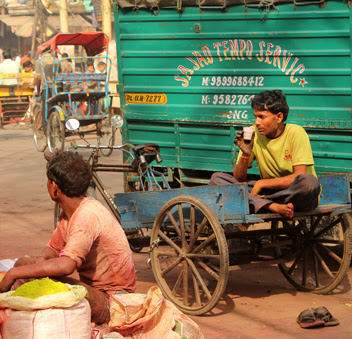 4. While you can have a cup of chai as a shopper in the bazaar, the chai vendor also serves his fellow workers. At Sadar Bazaar in Delhi, the cycle rickshaw wallah, the auto rickshaw wallah and the tempo driver, all of whom bring the agricultural produce and other goods to the market in the early hours of the morning have their tea served to where they choose to rest.
 5. The chai stall in the town of Patan in Gujarat has a generous sitting place that belongs to the street. The tea seller uses a public space for private consumption and this borrowed space becomes a place of social exchange that he offers his regular customers.
 6. Sketch Plan of Chai stall in Patan: The tea vendor is part of a layering process that has spatial elements – those that mark his own territory and those that circumvent his territory
 7. In Gujarat as in other parts of India, you can buy yourself adrak chai on the streets and you may have a choice of a plastic cup or a ceramic cup and saucer to suit your own levels of hygiene and nostalgia
I first began to think about the place of Chai in Urban spaces when I had the chance to listen to Philip Lutgendorf present his research work at Dakshinachitra on the Indian Tea. Here is a link to: Chai Why? – The Triumph of Tea in India
And, this is an interesting blog on the Irani cafes in Mumbai: http://www.iranichaimumbai.com/
Read about:
The Golla wallah
The Informal Economy & Urban space
Peanut festival in Bangalore
The Pani Puri wallah

The tea or “chai” has a special place in the homes of North Indians with its range of flavours to choose from. There is the Adrak-ki-chai (ginger tea), the Elaichi-chai (cardamom tea), the Dalchini-chai (cinnamon tea) or the Pudina-chai (mint tea) and with every cup, you add to your memories of a morning of reflection, an afternoon of family decisions or an evening of sharing with a friend. As I look closely at tea stalls in the streets and bazaars of Ahmedabad, Udaipur or Delhi, I realise that there are so many different ways in which people gather in public spaces "for a cup of chai".
As people participate in the buying and selling of goods in the Bazaar or Marketplace, they exercise control over the space in which they are situated and which surrounds them. For vendors, this control is the ability to transform some part of the bazaar environment to support their economic activity and sometimes their social needs as well. It is this transformation process that the chai stall seems to symbolise as it becomes the point of departure for economic and social exchanges in the marketplace.


I first began to think about the place of Chai in Urban spaces when I had the chance to listen to Philip Lutgendorf present his research work at Dakshinachitra on the Indian Tea. Here is a link to: Chai Why? – The Triumph of Tea in India
And, this is an interesting blog on the Irani cafes in Mumbai: http://www.iranichaimumbai.com/
Read about:
The Golla wallah
The Informal Economy & Urban space
Peanut festival in Bangalore
The Pani Puri wallah


 Posts
Posts


