Showing posts with label the Informal sector. Show all posts

Sunday, May 27, 2012

Gujari Bazaar – the 600 yr old market

I reached Ellis bridge in Ahmedabad on a really hot afternoon in March this year. I was seeing for the first time the Gujari Bazaar. I had heard about it many times before. I had read about it before I came here. This self-managed bazaar was locally called the ‘Ravivari’ or Sunday market. It had more than 1200 registered traders, most of them selling used items and a few selling new goods.The livelihoods of nearly 20,000 households were linked directly and indirectly with this market.

One would think that anything 600 years old would look old. It didn’t. With the way people went about in the bazaar, this did not look like a part of a period film. It just looked like a crowded bazaar that belonged to the present. However, it was a present that was part urban and part rural. As I entered the bazaar from one end of the Ellis bridge, there was a line of street vendors selling fruit on what seemed like high wooden platforms until I realised that they were camel carts (without the camels).

Ahmedabad was a city that had continued to be both urban and rural with nomadic tribes living in some neighbourhoods, with artisan communities settling here from other parts of Gujarat, with the city bearing ways of living that reflected traditional customs alongside contemporary needs that it was never quite urban in the way western societies define ‘urban’. It reminded me of the “urban-rural continuum” that Kerala had been known to have (in discussions about vernacular architectural traditions) with no discernible boundaries between the paddy fields and urban infrastructure.

The question that came to my mind was: How does a bazaar sustain for 600 years? For anything to sustain, it must be resilient enough. We do know that. How was this resilience built into our traditional bazaars? Was it in the nature of the people who sold their wares? Was it in the relationships and networks on which the buying and selling rested, that the resilience was embedded? Was it in the indigenous credit systems? How much of these still survived? Why had this bazaar not gradually faded away or been buried into the history of the city of Ahmedabad?

As I think about it now, knowing that it was a 600 year old bazaar had been so much in my mind before I reached there and after I got there, that I could think of nothing else for some time. As John Berger says in his book, The Ways of Seeing – “The relation between what we see and what we know is never settled” What I also knew from before was that this vibrant bazaar was in the centre of controversy – the Sabarmati Riverfront development project threatened to displace the bazaar that had been a source of livelihood for several vendors. The Gujari bazaar had a long, long history, but a short-lived future.

The historical background of the bazaar tells us that it was started in 1414 by Sultan Ahmed Shah, the Founder of Ahmedabad. At that time, it operated on Fridays and spread from Teen Darwaza to Bhadra Taar office. The 1941 communal riots had forced the closure of the bazaar for some time. It reopened a few months later, first near the Siddhi Sayyed mosque and later near the old Civil court. It was in 1954 that it was finally shifted to the Sabarmati riverfront at its present location.


Today, the Gujari bazaar is seen as a marketplace that belongs to the ‘Intangible Cultural heritage’ of the city of Ahmedabad. It has been included by the Centre for Environment Education (CEE) in its ‘Project Parampara’ which is a documentation initiative supported by the Ministry of Culture. There are three films on the Gujari bazaar which can be accessed at http://www.paramparaproject.org/traditions_gujari-bazar.html which highlight the role of the Gujari bazaar association and the linkages between artisans and traders who have participated in the bazaar for many generations.
The short-lived future of the Gujari bazaar has been discussed in public meetings and efforts continue to be made by not-for-profit organisations and educational institutions in the City to propose alternatives to the displacement of tradition and livelihoods. In December 2009, a Public hearing was held in Ahmedabad to discuss displacements experienced by the poor and included the case of the Gujari bazaar. This is a link to the Report of Public hearing on Habitat and Livelihood displacements.

The verdict of the jury had said that the Gujari bazaar was a heritage activity of the city and its shifting needed to be re-examined by the Ahmedabad Municipal Corporation with the participation of the traders. A forum of concerned citizens of Ahmedabad called ‘Our Inclusive Ahmedabad’ had organised this Public hearing and continues to battle with the government for the rights of the vendors.

If an informal, temporal marketplace has been a part of a city for six hundred years, why would we want to let it go? It's time perhaps to reflect on sustainable development as Indians understood it in the past. What cultural processes and planning processes did they deploy that we can learn from? What can we remember from what we know from our past that will help us design a better future for our cities?

Here is a link to: www.gujaribazaar.org which discusses the Livelihood and Community-related aspects of the bazaar and the efforts of management and design professionals from IIMA and NID towards working with the Ahmedabad Gujari Association in the recent past.

Related Posts:
The Riddle of Russell market
Gandhi Bazaar: Street vendor eviction
The Informal Economy and Urban space
The Politics of the Marketplace

Tuesday, March 06, 2012

The Riddle of Russell market

There are two riddle questions that seem to come out of the fire that damaged the Russell market ten days ago.

1. What really caused the fire – conflict or neglect? 
I read in The Hindu on 25 Feb 2012 Bangalore's Russell market gutted that it was an electrical short circuit that caused the fire. But, the vendors say it is a big plan of the government to get them onto the footpath and out of the 2-acre property. One vendor I spoke to said “How could an electrical short circuit spread so much and destroy such a large part of the market in a time period of half an hour?”. Another vendor insisted on explaining that “The Fire Department was also with THEM. They were dousing water with high pressure pipes onto the cast-iron columns instead of onto the wood that was on fire. You see, that is why the cast-iron pillars are now bent, whilst the fire continued to spread and cause damage”. Speaking to the vendors six months ago, I had learnt that the rent paid by each of the shopowners inside the market building is Rs.200 per month. They do not want to pay more. The municipal corporation has been refraining from proper maintenance as a result. Why have the vendors not agreed to paying more? Why has the government kept away?

2. Will the government eventually demolish the market building to build a mall?
The government has been denying having any plans for acquisition of the Russell market property to build a mall here. Municipal Commissioner M K Shankarlinge Gowda  has said “There are no plans before the BBMP to demolish the existing structure. Besides, it is not a suitable place to build a shopping complex” (Source: IBN Bangalore)

But, the vendors have formed a new association last week, where the fruit vendors, the vegetable vendors and other small vendor groups can collectively form a stronger force that the government cannot displace. They had a puja on last Thursday morning which received some media attention. I learnt from the Secretary of the Vendors association that they were so determined now to hold a grand Exhibition in December (it was an old tradition during the British times) at the Russell market and that there was nothing the government could do to take their market away from them.

It’s difficult to know what is true, but important nevertheless that we find the right answers because in all of this conflict and neglect, we almost LOST a historic market of the city. If perceptions need to change, how do we do that? If perception IS reality, then, how do we effect change?
-------
I am posting here some photographs from last week's visit to Russell market the morning of the Puja. It was a complete change from the days immediately after the fire, pictures of which are at:
Russell market after the fire

The main entrance of the Russell market on 1st March - the day of the Puja


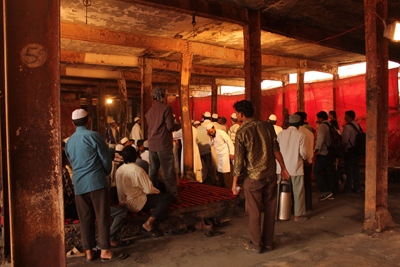
The priests from Muslim educational institutions all over the city being served a meal after the reading of the Quran.


This was the part which had been damaged completely and can be seen in the previous post pictures as well.


Some of the vendors intermittently came in to participate in the Puja. In one side of the market building, business was going on as usual.


While the priests read, the chaiwallah looked on.


While the priests read, the newspaper reporters and the television channel photographers documented what went on. 


Life was getting back to normal on the day of the puja 


There was after the Quran reading, a Hindu priest performing a puja.


Was this the same market courtyard we had seen a week ago?

Tuesday, February 28, 2012

Russell Market after the fire

It was on the morning of 25th Feb 2012 that the fire caused severe destruction at the Russell market in Bangalore. As I stood in front of the Russell market two days after the fire, I saw that the outer façade had not been affected and did not show any external signs of damage. I entered the building and looked towards the popular dry fruit shops to the left, but they weren’t there. It was just a black space with people randomly walking about. One half of the market was functioning, in the other half, the shops and goods had been completely burnt down. I had read in the news article Bangalore’s Russell Market gutted in The Hindu that the fire was believed to have been caused by an electrical short circuit and that 174 shops had been damaged.

As I walked further down the market building, there were people cleaning up the debris – wooden poles that were charred, windows that were wrecked, plastic items that had melted into one blackened mass and objects that couldn’t be identified properly anymore. Some people cleared the debris, others stood there watching. The vendors said that the debris had to be cleared away so that life could go on. Some of them had lost goods worth more than a lakh of rupees since they had stocked up for the weekend when sales at Russell market were twice as much as on weekdays. They said they could not wait for the Municipal Corporation to clean up the mess since the Corporation might take 15 days to cart away the debris.

The vendors say that the BBMP - Bruhat Bengaluru Mahanagara Palike had suggested that this dilapidated and now damaged structure could be demolished completely so that a new shopping complex with basement parking could be built here. The vendors had decided that they would not vacate the premises since they did not want this heritage building to be brought down. Besides, they were not sure how long the Municipal Corporation would take to complete the work and whether the alternative location provided to the vendors in the meantime would be as good as this one. The vendors now planned to reconstruct the shops themselves in as little time as possible so that their business could continue.

There has been an on-going disagreement between the Vendors at Russell market and the Municipal Corporation about rent prices of shops inside the market building, about maintenance of the interior of the building and about garbage disposal. The vendors do not want to pay the rent that the Corporation thinks appropriate and the Corporation therefore has refrained from maintaining the market building or its surroundings. In an earlier blogpost Oral history at Russell market, I have included excerpts from interviews with the vendors and think that understanding their beliefs and their doubts could lead to working out a better urban regeneration plan for the Russell market precinct which may or may not entirely meet their demands but can be implemented successfully if the communication between the stakeholders and the Government improves considerably.

It is seldom that vendors in a fruit and vegetable market in any part of the world have had their demands met by the City corporation and not often that the City knows how to overcome its own difficulties of managing a market in an expanding Inner city core. I wrote about this earlier at Planning for the transition. The vendors’ want better amenities within the market building so that they can have a more efficient workplace as well as better parking facilities so that they do not lose the customer base they have built up over many years. In a city core that gets denser with an increase in population, increase in commercial activity and an increase in traffic congestion, this is usually difficult to solve.

In a Market redevelopment project, a design solution that takes into consideration the functioning of the entire urban precinct enveloping the site of the fruit and vegetable market building may be more appropriate than focusing on a site-specific architectural solution. A bazaar in India usually originates with a market building and grows into several intersecting streets lined with shops and eventually develops into an entire market precinct. For instance, we have the Crawford market in Bombay, Manek chowk in Ahmedabad, the Lad bazaar in Hyderabad and the Russell market in Bangalore. These are the Inner city cores where formal retail and informal retail grow simultaneously and must both be understood so that we can generate an integrated development plan. I wrote earlier about The Informal Economy and Urban space, a post that focuses on the wholesale tomato market outside the Russell market, a temporal marketplace that operates for an intense two hours every morning.

Whilst the fire at Russell market will require that the inside of the building be given adequate attention so that livelihoods can be resurrected at the earliest, there have been issues that affect the vendors and the public that lie outside of the market. One of the key questions will be how can we resolve the parking problems which are currently affecting the business of the shopowners both inside and outside the market building as well as making it difficult for the traffic to manoeuvre its way through the increasing congestion on the roads? Will it help to survey the adequacy of the Parking facility built above the Shivaji Nagar bus stand and the roads leading up to it? Traffic congestion is a problem that the entire city of Bangalore is currently battling with. An article in The Hindu, Why do we find ourselves in such a jam today? discusses the vehicular growth in Bangalore over the last ten years, the draft Parking Policy and possible solutions for improving the movement of traffic on the roads.

The second key question will be how can the Municipal Corporation generate revenue so that it can maintain the market and its surroundings better, without the city having to lose a traditional bazaar and a heritage building? With heritage market buildings, it is attractive for the Municipal Corporation to take acquisition of the land and find a more lucrative use for it since the price of the land is higher than the value of the building that sits on it. The need to conserve architectural heritage is difficult to fathom in the strife for generating revenue for the city and improving its infrastructure. For the phenomenal numbers of people that live in every Indian city, it is amazing how cities work here. However, for citizens to appreciate the efforts of the government, perhaps the city needs to function even more efficiently or the government must be able to communicate to its people why it is unable to do better and how the public must contribute.

Related posts:

Tuesday, February 14, 2012

Gandhi Bazaar: Street Vendor Eviction

The Street vendors at Gandhi Bazaar were evicted on Jan 23 and it’s now three weeks since then. There is more than one reason being cited for the Gandhi Bazaar main road being cleared of street vending. An article in the Deccan Chronicle on Jan 25, 2012 says, "The BBMP authorities said there was a demand from the traffic police and members of the public to clear the footpath and the road to ensure smooth movement of pedestrians and vehicles". So, it is the traffic congestion and the inconvenience to the public that seems to have triggered the eviction.

When I spoke to the residents of Basavanagudi, I learnt that the vendors are  now quite arrogant and rude so unlike the way they were in the past. The residents say that the vendors infringe on more urban space than they can manage within. The objection to street vending from the residents was related more to the behaviour of the vendors and the government's objection was related to the traffic congestion that street vending was contributing to.

Some months ago, I had read a paper – Lessons from the Unbuilt Tagore circle underpass by Dr.Vinod Vyasulu, Centre for Budget and Policy Studies. The reason I think about this now is because the underpass construction that started in October 2009 has caused so much traffic congestion and one wonders if the need to evict the street vendors would have arisen if the underpass work had never begun. I reproduce here an excerpt from Dr.Vyasulu’s paper:

Why did work start before it was clear that land would need to be acquired for the service road? What alternatives were debated within the BBMP before deciding upon this? Why was no attempt made to share information with the residents of the area? Why were no public hearings held? Why now, in the middle of construction are alternatives not being debated?
    There are alternatives.
We could fill up the mess and go back to the old situation. Apart from the BBMP losing face—and money being wasted, this would be the best option as this underpass was never needed. Why cannot this be debated openly?

There could be several reasons for the traffic congestion, one, the street vending, second, the construction of the underpass, thirdly, the lack of a service road after the commencement of the underpass and perhaps also the parking of vehicles along the Gandhi Bazaar main road.

The Gandhi Bazaar main road on Feb 13, 2012 and the absence of flower sellers outside the Vidyarthi Bhavan 

If you look at the Gandhi Bazaar main road from the Tagore Circle end, you find a continuous row of two-wheelers randomly parked along the footpath and further down, a line of cars parked along the road. There are signs put up by the municipality that confirm that there is “Parking for cars” and “Parking for two-wheelers”. There is organised parking that occupies such a large part of this shopping environment which ought to be dedicated more to pedestrians and less to cars.

While the act of street vending is brought under strict scrutiny by the government, it may also be worthwhile to understand how the traffic works, why it transits through this street and whether the cars that park or transit here have direct linkages to the shopping activity which is the mainstay of this urban space. A thorough study of the users of the cars would tell us if the cars parked here belong to the shoppers who use the street bazaar, to the shop-owners or to the offices located in the vicinity and it could be worked out what percentage of the space can be allocated to whom.

In order to decongest the Gandhi Bazaar main road, we need to ask ourselves what are the causes of the street not functioning properly anymore – the increase in the vendor population, the increase in the resident and shopper population, the lack of enforcement of parking regulations or the unjustified construction of the underpass? Perhaps, we need to prioritise our objectives – is it to provide a better environment for the residents of Basavanagudi, is it so that the street functions efficiently as a transition zone, is it to improve the hygiene conditions in this region or is the objective linked to a decision about an underpass that cannot now be retracted from action.

In the future, to make a Street better, can short-term experiments be carried out to determine the extent of change required? Can these include conducting a meeting of Shopowners, Street vendors and Users of the area to know their views on the day-to-day problems and implementing some of their recommendations? Can we seek comments and suggestions from the citizens of Bangalore, through a market survey? Or, can we have an exhibition of an Urban Planning draft proposal, which would be open to the public inviting their views in a visitors’ book or in a follow-up workshop to be attended by organisations and old residents of Basavanagudi?

An initial Urban Planning Survey at Gandhi Bazaar may ask questions such as: How did Gandhi Bazaar originate? How many street vendors operating here have a legal status? What is the length or extent of the street that makes Gandhi Bazaar? What are the average walking distances for customers? How many people enter Gandhi Bazaar every day? Of these, how many are buyers and how many are in transit going somewhere else? What are the roads that surround the Gandhi Bazaar, what roads connect here? How does this street connect to the neighbourhood it lies within? How does it influence what happens in the localities adjacent to it? What have been the government interventions over the last 20 years at Gandhi Bazaar? What are the views and thoughts of the regular customers of the Gandhi Bazaar? How much of the Urban Street Vendor Policy 2009 has been implemented in the city? How are the Town Vending Committees to be constituted at the city level functioning? Who is responsible for this?

We need to know what works, what does not work and what are the costs involved in making a better street and a better city. There is so much to know before we start to come up with appropriate solutions that solve our infrastructural problems, our livelihood issues and give us urban habitats that match up to the “world class city” that we seem to be wanting in India all the time, without wanting to find out how people live their everyday lives and what the day-to-day needs are.

Related Posts:
The Informal Economy and Urban space
Territoriality in the Indian Bazaar
A Street bazaar and the City
Pedestrianising Gandhi Bazaar

Friday, January 06, 2012

What is Chai

And, why is the chai so much a part of our lives? In India, we believe that time is cyclic and in the many years we live before we are reborn again, the chai is at the core of our existence. It is the cup of chai (tea) that helps us mark time in our homes, in our streets, in our marketplaces. Every home offers its guest a cup of tea. Every street corner offers its visitors a glass of chai. In the marketplace, the chai creates the social space that people need as an introspection, an interaction or a sharing of experiences.

The Chai glass: in a Street in Udaipur

The tea or “chai” has a special place in the homes of North Indians with its range of flavours to choose from. There is the Adrak-ki-chai (ginger tea), the Elaichi-chai (cardamom tea), the Dalchini-chai (cinnamon tea) or the Pudina-chai (mint tea) and with every cup, you add to your memories of a morning of reflection, an afternoon of family decisions or an evening of sharing with a friend. As I look closely at tea stalls in the streets and bazaars of Ahmedabad, Udaipur or Delhi, I realise that there are so many different ways in which people gather in public spaces "for a cup of chai".

As people participate in the buying and selling of goods in the Bazaar or Marketplace, they exercise control over the space in which they are situated and which surrounds them. For vendors, this control is the ability to transform some part of the bazaar environment to support their economic activity and sometimes their social needs as well. It is this transformation process that the chai stall seems to symbolise as it becomes the point of departure for economic and social exchanges in the marketplace.

1. a Shopowner sipping his morning cup of tea as the street bazaar begins to ready itself for the day’s customers

2. a Chai stall in Ahmedabad that manages its operations on a push-cart with its customers standing around the cart and exchanging the morning news or discussing the day’s work.

3. The functional space requirement for the making of the tea is quite minimal and the tea vendor needs a supply of water for the tea and for the washing to fulfill his operations at the marketplace.

4. While you can have a cup of chai as a shopper in the bazaar, the chai vendor also serves his fellow workers. At Sadar Bazaar in Delhi, the cycle rickshaw wallah, the auto rickshaw wallah and the tempo driver, all of whom bring the agricultural produce and other goods to the market in the early hours of the morning have their tea served to where they choose to rest. 

5. The chai stall in the town of Patan in Gujarat has a generous sitting place that belongs to the street. The tea seller uses a public space for private consumption and this borrowed space becomes a place of social exchange that he offers his regular customers. 

6. Sketch Plan of Chai stall in Patan: The tea vendor is part of a layering process that has spatial elements – those that mark his own territory and those that circumvent his territory

7. In Gujarat as in other parts of India, you can buy yourself adrak chai on the streets and you may have a choice of a plastic cup or a ceramic cup and saucer to suit your own levels of hygiene and nostalgia

I first began to think about the place of Chai in Urban spaces when I had the chance to listen to Philip Lutgendorf present his research work at Dakshinachitra on the Indian Tea. Here is a link to: Chai Why? – The Triumph of Tea in India

And, this is an interesting blog on the Irani cafes in Mumbai: http://www.iranichaimumbai.com/

Read about:
The Golla wallah
The Informal Economy & Urban space
Peanut festival in Bangalore
The Pani Puri wallah

Sunday, August 08, 2010

Fashion street in Mumbai

This is a guest post written by Radha from The Musings of a Night Owl. I would like to thank Radha for accepting to share her bazaar experience on this blog. Radha writes about the Fashion Street in Mumbai which was a place much frequented by those of us who grew up in Bombay. Within the informal street bazaars, there are some that grow to be an undeniable part of the urban space of the city.


Hawkers and street vendors are a part of life in India.  And life is unimaginable without them.  Both for  the conveniences they provide or the nuisance and hindrance they create.  Each town and city has its popular roadside markets. The Supreme Court has pointed out that, the use of public streets and pavements is first meant for the use of the general public; they are not laid to facilitate the carrying on of private business (Supreme Court in Bombay Hawkers' Union vs.Bombay Municipal Corporation – AIR 1985 SC 1206). They have also laid down guidelines for hawkers.

Mumbai has been divided into Hawking Zones, Prohibited Zones, and Rest of the City.  Hawking zones need to have demarcated pitches on roads selected as per stated criteria. This would accommodate around 23,000 hawkers, selected by lottery every year. One such hawking zone that is very popular in Mumbai is the Fashion Street. Located on the M G Road between Cross Maidan and Azad Maidan under the shade of  some lovely large old banyan trees, the place is ideal for those looking for trendy clothes and accessories at a bargain.

Branded clothes, that one might imagine being purchased at a boutique store, would probably have been bought for a song at the Fashion Street. Around 200 stores of sheer shoppers delight. Items stocked are export rejects, maybe for a missing button, a cross print, wrong size, but otherwise excellent quality. Prices quoted initially would be in excess of what one might expect at a high end store. The trick is to start at about half the price and gradually arrive at a price agreeable to both. The vendors here may seem uneducated but are good at a smattering of all languages both Indian and foreign. 

I was with a group, that had a respite from wedding festivities. Off for a bit of sight-seeing, without any serious intention of shopping, we landed at this place. My sister-in-law picked up some stylish dresses for her grandchildren. 

At one store, I looked at a pair of sandals, more out of curiosity.  The vendor was attending to someone but when he caught my glance, immediately pulled out a stick to bring down the sighted pair. And quoted a price of Rs. 400/-.  Seeing my disinterest he lowered the price a bit. I walked away, he did not pursue. Probably waiting for a reaction. I had already walked maybe a hundred yards away looking at another stall, when he walked up to me, asked me to return and take the sandals at ¼ th the cost. It was a size too small for me, but at Rs. 100/- it was a steal, and I could always find someone who could fit into them.

After an hour at Fashion Street we walked away with loads of packets in our arms. Purchases at a bargain. It did not really matter if we had use for them or not. 

Sunday, May 10, 2009

the Gateway & its small enterprises

At the Gateway of India in Mumbai simply watching who were the small vendors here. There was the man who sold you a picture of yourself in front of the famous Gateway of India, as soon as you ordered one.


The old man looking out for customers who wanted to buy bird feed, for the pigeons.


The ever-so-happy-go-lucky man selling warm, roasted peanuts that have always been nicer bought at the street corner than when bought in a packet at a supermarket.

Tuesday, September 18, 2007

Bazaar on Konkan coast


In Maharashtra, the coastline belongs to the Kolis or Fishermen. The men go out to sea to catch the fish. The women sell the fish at the local bazaar. Koli women focus on the quality of the product. That is all that matters. And, if you don't trust them when they say the price is good and the fish fresh, you can go take a walk!!


There are no "circulation paths" in the Maasali bazaar or Fish market at Murud Janjira, which has today become a weekend getaway for Bombayites and where the Janjira fort stands in the waters of the Arabian sea. You "circulate" without a plan. You "circulate" without a thought. You "circulate" as if you are in the waters of the ocean. With every wave, you change where you are and what you do.


There is an indoor market and an outdoor market. Inside, there is tranquillity. Outside, chaos reigns. The market structure has little openings in the walls and some places in the roof, that bring in the sunlight beautifully. The vendors here have time to chat with you as you stroll around the few lanes within.

There is the countrywood jali which generates good cross-ventilation within the bazaar building. The walls are white. The sunlight is a serene spotlight from above that sometimes puts the women on centrestage and sometimes the fish.


Other posts on Fish Bazaar:

Fish market at Sassoon Docks

Sunday, July 01, 2007

Understanding the informal sector

In Visakhapatnam, petty trade flourishes at street corners, on the footpaths and on small pieces of Municipal Corporation of Visakhapatnam (MCV) lands that are unoccupied. The petty traders use tree cover or a baddi i.e. a kiosk for a shelter. They are increasing in number, causing congestion and occupation of lands that can be more suitably used. The Corporation felt the need to relocate these traders to alloted spaces. Initially, more than 15 sites were identified by MCV for a bazaar that provides spaces for petty trades.

It was necessary to perceive the problems faced by Petty traders in the city and those faced by the Municipal Corporation due to the existence of petty trade activities. The initial observations showed that Cost is a major factor in selection of the type of stalls that are seen at random locations all over the city. Twenty years ago, a baddi of size 6’-0” x 6’-0” could cost Rs.5,000. Today, the same baddi can cost upto Rs.20,000. Having stood the test of time, these baddis are probably the most appropriate and cost-effective solutions as shelters for business. The spontaneity of the entrepreneur and his family in creating a suitable work environment results in individualistic designs.

The infrastructural costs are kept low by occupying street junctions, footpaths and vacant lots, instead of purchasing regular shops. The hawker uses sometimes a bedsheet to spread out his wares, or a few wooden crates that make a small platform or a kiosk (these are made from wooden planks from used cargo crates for the walls and asbestos sheets for the roof). These baddis or kiosks do not require lengthy procedures for approval by the authorities. A shop constructed in brick and plaster with an RCC slab roof can be built and occupied only after submission of architectural plans to the Municipal Corporation. This can be time consuming and of course more expensive.

The design for the petty traders project took the form of a tree, a pergola and a barrel vault.